How to prevent and control loose curds, hairy curds, early flowering and non-heading in autumn cauliflower
Cauliflower prefers cool weather and is demanding in its requirements for the environment and cultivation methods, especially early-maturing varieties, which are even more sensitive to external conditions. In recent years the weather has often been abnormal, with temperatures rising and falling unpredictably, so growers should pay close attention to the following problems during cauliflower cultivation.
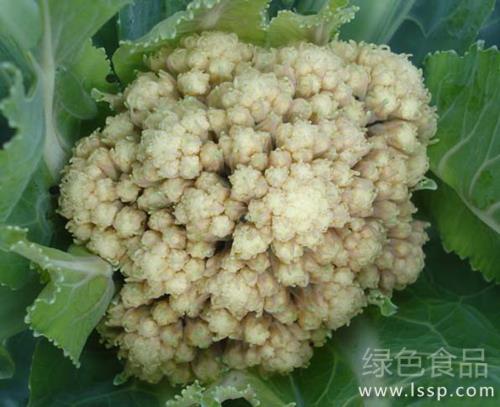
Hairy curd in cauliflower
1. Early flowering (small curd) Causes:(1) Spring-sown cauliflower varieties grow weakly after sowing or are subjected to excessive seedling hardening; after passing through the vernalization stage early, they form small curds due to poor nutrition; (2) Autumn sowing of cauliflower is too late, especially for early-maturing varieties, or fertilizer and water are insufficient, so that before the leaves have fully grown they encounter temperatures suitable for curd formation, resulting in poor nutrition of the curd and the formation of small curds. Preventive measures: First, sow spring varieties at the proper time according to variety characteristics; those planted early need short-term covering with a plastic tunnel to avoid a long period of low temperature at the seedling stage; second, do not subject early-maturing autumn cauliflower to seedling hardening after planting, and supply fertilizer and water promptly so that the cauliflower completes its vegetative growth within a certain growing period.
2. Green curd:The green bracts or sepals on the flower branches on the surface of the curd grow prominently, which is called green curd. Causes: too much nitrogen fertilizer and excessive vegetative growth, plus temperatures continuously above 20°C during curd development, cause flower primordia to differentiate into leaf primordia, so that small leaf blades appear among the curd. Preventive measures: balanced fertilization; in rainy years, control excessive growth of cauliflower.
3. Purple curd:The surface of the curd turns purple. Causes: a sudden drop in temperature when the curd is exposed or nearing maturity damages the physiological functions of the cauliflower, disrupting metabolism, and glycosides convert to anthocyanins, causing the curd surface to turn purple. Preventive measures: when cultivating late-maturing cauliflower varieties, pay attention to weather forecasts, spray 1% brown sugar water + 0.4% potassium dihydrogen phosphate before strong cooling weather, and harvest in good time.
4. Hairy curd:Hair-like growth on the surface of the curd is called hairy curd. Causes: (1) sowing at the wrong time; curd formation requires low temperatures, so if the sowing period is wrong, after the curd has formed, high temperature and drought easily lead to hairy curd. (2) Poor field management; cauliflower has poor tolerance of drought and waterlogging, so hairy curd easily appears. (3) Harvesting too late. Preventive measures: (1) choose a suitable sowing period according to variety characteristics; (2) strengthen field management, and choose a plot for cultivation that can be irrigated in drought and drained in waterlogging. As self-covering ability is poor, remove leaves in good time to cover the curd tightly. (3) Harvest at the proper time.
5. Loose curd:The flower branches of the curd elongate unevenly, causing the curd to be loose and not firm. Causes: harvesting too late, the curd becoming over-mature, insufficient water and fertilizer, the curd being checked in growth; excessive seedling hardening, causing the curd to stop growing and age; excessively high temperature, unsuitable for curd growth; damage from pests and diseases, etc. Preventive measures: treat the specific cause.
6. No curd formation:The cauliflower only grows stems and leaves and forms no curd, resulting in reduced yield or total crop failure. Causes: (1) autumn sowing too early, with high temperatures, so the seedlings do not experience low temperature and cannot pass through the vernalization stage; (2) spring varieties used for autumn sowing, because the leaf rosette growth period is long, so the curd formation period meets low temperatures, resulting in no curd formation; (3) autumn varieties planted in spring, because the seedlings pass through the vernalization stage too early, the small curds that form quickly bolt and flower and cannot form a curd; (4) too much nitrogen fertilizer and no seedling hardening, causing excessive growth of stems and leaves, so that no curd can form, or it disintegrates prematurely. Preventive measures: correctly select cauliflower varieties, sow at the proper time, create the conditions for cauliflower to pass through the vernalization stage, apply additional fertilizer appropriately, carry out seedling hardening, etc.