Causes of Deformed Chinese Yam Being Hard to Sell and How to Prevent Them
During the growth of Chinese yam, the internal tissue structure of some tubers changes due to the influence of the environment, cultivation measures, management methods and many other aspects, which makes the Chinese yam become oddly shaped.
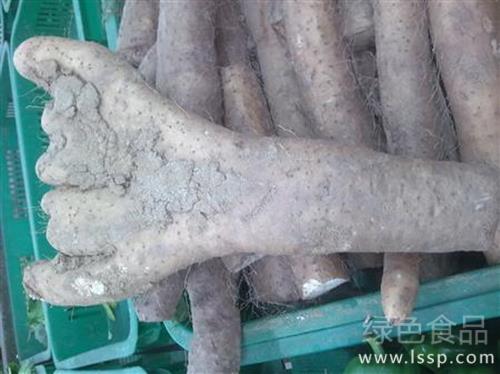
Deformed Chinese yam
I. Germplasm factors:Large-scale cultivation of Chinese yam mostly uses yam buds and yam seed pieces. Yam buds and cut yam pieces have been cultivated in the soil for at least one year and are prone to carrying root-knot nematodes, anthracnose, brown rot pathogens, and so on. After seed pieces of Chinese yam carrying pathogens are planted, if conditions are suitable (high temperature and heavy rain in June to July), the disease breaks out over a large area, causing deformed growth of the Chinese yam. In addition, 1- to 2-year-old yam buds are rather expensive, and some people who seek small bargains use yam buds that have been cultivated for 4 to 5 years. Because the yam buds have aged, they are prone to mutation, forming deformed Chinese yams such as forked and curved ones. Preventive measures. 1. Soak yam buds or cut yam pieces in a 500-800 times dilution of mancozeb or in carbendazim for 3-5 minutes to kill pathogens. 2. Use 1-year-old yam buds cultivated from high-quality yam beans as seed. 3. Use yam buds or cut yam pieces 20-25 cm thick as seed, which helps form thick, strong stems and vines and enhances disease resistance of the Chinese yam.
II. Soil factors:1. Soil quality directly affects whether Chinese yam tubers can grow healthily. In black clay soil, Chinese yam tubers are mostly snake-shaped or sole-shaped, and the tuber root hairs are thick and numerous; in sandy soil, Chinese yam tubers are slender and not thick enough. 2. Where the underground water table is shallow, Chinese yam grows poorly, and the roots and tubers are prone to becoming damp and rotting. 3. Continuous cropping plots have many diseases and pests, and under the influence of hormones secreted by the roots, the tuber skin color darkens and quality deteriorates. Preventive measures: 1. Use plots that have never been cultivated with Chinese yam; continuous cultivation can be done for 3 years, opening furrows on the ridge backs of the first year's Chinese yam cultivation in the second year, and planting in the first year's cultivation furrows in the third year. 2. Choose sandy loam or loam with high, dry terrain, good drainage and deep soil layers for planting, and require the upper and lower soil texture to be consistent.
III. Planting factors: 1. The trench is not dug deep enough. If the Chinese yam trench is too shallow, after the meristem at the basal end of the Chinese yam tuber extends to the bottom of the trench, it grows sideways, becoming sole-shaped or snake-shaped. 2. The soil in the trench is uneven. During the growth of the Chinese yam tuber, when it encounters bricks, stones or hard clods of soil, it is prone to bending and deformation. 3. Improper placement of yam buds. If yam buds are placed improperly, 2-3 stems are produced, and if not handled in time, multiple tubers are easily formed, affecting the quality of the Chinese yam. Preventive measures: 1. Dig the trench deep enough; the depth depends on the Chinese yam variety. Most Chinese yam tubers are 1-1.3 m long, so the trench should be more than 1.3 m deep. 2. Before planting Chinese yam, apply organic fertilizer mixed in, and rotary till the 20-30 cm soil layer of the Chinese yam trench 3 times so that soil and fertilizer are mixed evenly. 3. When placing cut yam pieces and yam buds, keep the strong bud at a 45-degree angle to the ground to maintain the apical dominance of the strong bud and inhibit the growth of other buds; at the same time, the strong bud should be placed sideways to facilitate the growth of the aboveground stems and vines and the elongation of the underground tubers.
IV. Management factors:1. Too much rain, or improper watering, causes trench collapse, affecting the growth of Chinese yam tubers and making them curved. 2. Pests such as white grubs and mole crickets bite and injure Chinese yam tubers, causing wormholes or forking. 3. Root-knot nematodes, anthracnose, stem rot and so on harm the leaves and tubers of Chinese yam. Preventive measures: 1. Water at the right time and in the right amount, and drain promptly during the rainy season to prevent trench collapse. 2. Organic fertilizer should be fully decomposed, and a small amount of trichlorfon should be mixed in to kill pathogens and pests. 3. Before planting Chinese yam, soak the seed in a 500-800 times dilution of carbendazim, and scatter fine sand or bran mixed with trichlorfon into the planting trench. 4. Starting in early June, spray a 500 times dilution of thiophanate-methyl or mancozeb once every 15 days to prevent and kill pathogens.