Control methods for cauliflower soft rot causing curd rot, foul odor and collapse
When cauliflower in the field is infected, the early stage shows plant wilting, wax powder shedding, mottled leaf surface, and wet rot at the leaf margins; the middle stage shows local rot of the leaf stalks, infection of the curd, and spread to the stem and flower branches; the late stage shows the stem and curd beginning to rot until the cauliflower collapses, with obvious foul odor at the larger wet rot areas on the leaf stalks, curd, and stem. When the leaf margins are affected, they appear dark brown when dry and pale yellow wet rot when humidity is high. When the leaf stalks, stem, and curd are affected, small water-soaked spots first appear, the epidermis remains, and the tissue is still firm; then the diseased area expands and deepens, rot begins, and a slimy liquid flows out.
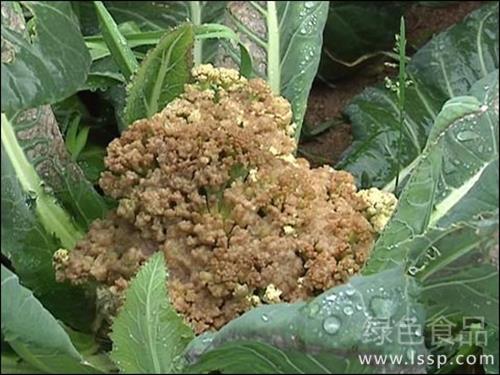
Cauliflower soft rot
Control methods: 1. Choose heat-tolerant, disease-resistant varieties. Green-stalk varieties, such as Qingnong 65 days, Qingnong 70 days, Qingnong 85 days, Nongmei 70 days; white-stalk varieties, such as Japanese Snow Mountain.
2. Crop rotation: severely diseased land can be rotated with less susceptible crops such as grasses and legumes; water-dry rotation is advocated, and continuous cropping with susceptible crops such as crucifers should be avoided as much as possible.
3. Field management: disinfect seeds and seedbeds, and cultivate disease-free strong seedlings; choose loose, fertile land and cultivate with deep furrows and high beds; increase application of calcium, copper, boron, and molybdenum fertilizers to correct soil nutrient deficiencies, avoid root damage from hole fertilizer and excessive nitrogen application; supply fertilizer and water in a balanced way to ensure the cauliflower grows robustly; control insect pests in time, prevent black rot early, prevent black rot and soft rot from occurring together, pull out initially diseased plants, and disinfect the diseased holes with lime.
4. Chemical control. Focus on prevention, spray promptly before and after rain, and around budding, focus on control to protect the leaf stalks, roots, and stem. Commonly used agents include 72% agricultural streptomycin sulfate or 1 million units of Xinzhiwomycin soluble powder at 3000-4000 times dilution, 95% Dexon wettable powder at 600 times dilution, copper-based agents, etc., and they should be used in rotation. If cauliflower soft rot is treated only by spraying, the effect is poor, especially in continuous cropping land and severely diseased land; root drenching must be combined, with 0.25-0.5 kg of medicinal solution per cauliflower each time, about once every 15 days, for 2-3 consecutive drenchings, with a control effect of more than 98%, and it can also control downy mildew, black rot, and black spot.