Control methods for foxtail millet downy mildew with mold on the leaf underside and dry, withered leaf tips
Downy mildew is one of the important diseases of foxtail millet. It can occur from the seedling stage to the maturity stage. After the seed germ or young tiller is infected, different symptoms appear successively at various growth stages and on different organs, and thus it gets different names: “bud rot”, “gray back”, “white tip”, “rifle barrel”, “white hair” and “hedgehog head”. In addition, local infection can cause leaf spots.
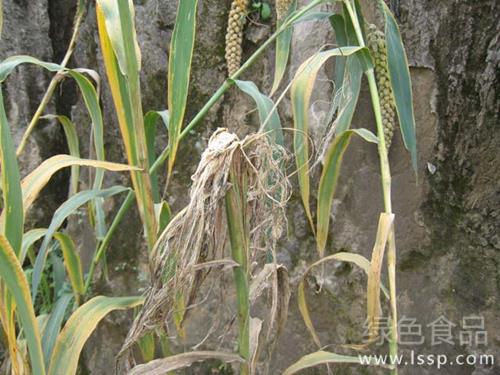
Foxtail millet downy mildew
Occurrence pattern: The pathogen of foxtail millet downy mildew overwinters as oospores. Under natural conditions there are three sources of primary infection: first, when diseased field tissues rupture, oospores fall into the soil, making the soil carry the pathogen; second, feeding infected foxtail millet to livestock or composting it makes manure carry the pathogen; third, when diseased and healthy plants are threshed together, the surface of the grain is contaminated with oospores, making the seed carry the pathogen. Among these, soil-borne infection is the main source of primary infection of the disease.
Different varieties of foxtail millet differ markedly in resistance to downy mildew. Early and deep sowing leads to severe disease, while appropriately late and shallow sowing leads to mild disease. All factors unfavorable to seedling emergence favor the occurrence of the disease. In addition, downy mildew caused by reinfection under warm and humid conditions is more severe.
Control strategy: seed treatment as the main measure, agricultural control as a supplementary measure, combined with the selection of disease-resistant foxtail millet varieties.
1. Chemical control: use 35% metalaxyl seed dressing agent at 0.2-0.3% of the foxtail millet seed weight for direct dry seed dressing or wet dressing with added water, or 50% metalaxyl-copper wettable powder at 0.3-0.4% of the foxtail millet seed weight for seed dressing, or 64% oxadixyl-mancozeb wettable powder at 0.4-0.5% of the foxtail millet seed weight for seed dressing. Sowing should be done immediately after dressing.
2. Agricultural control: rational crop rotation can effectively control foxtail millet downy mildew; two-year rotation in lightly affected areas and three-year rotation in heavily affected fields. Rotate with non-host crops such as wheat, legumes, and tuber crops. Apply sterile fertilizer and carry out seed treatment. Large-area rotation gives better results. Pay attention to preserving soil moisture, sow at the proper time, and sow appropriately shallowly to promote early and strong seedlings and reduce infection opportunities. In addition, pulling out diseased plants with gray back and white tip can effectively control the occurrence of foxtail millet downy mildew the following year; pull them out promptly, continuously, as whole plants, and year after year, before the oospores of the diseased plants are shed. Take the pulled diseased plants out of the field and burn them in a centralized manner; do not feed them to livestock or use them for composting.