Seven key points for autumn management of citrus, ensuring a quality harvest this year and a bountiful yield next year
The task of autumn management in the citrus orchard is to apply the right measures according to the tree's growth and development and the weather characteristics, ensuring citrus quality and a bountiful yield, while also maintaining good tree vigor to lay the foundation for a bountiful and stable yield the following year. In citrus-producing areas, do well in seven aspects:
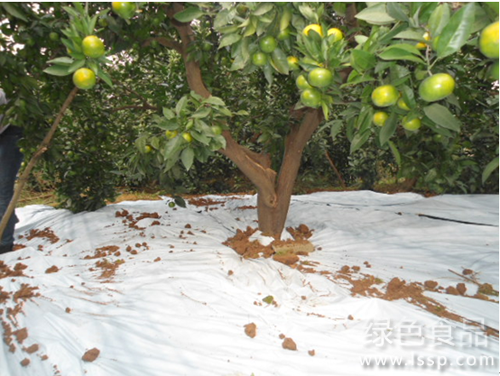
Mulching citrus to increase sugar content
Mulching to increase sugar content: In order to increase the soluble solids content of citrus and improve the flavor and storability of the fruit, lay reflective film before harvest.
Drainage and waterlogging prevention: Autumn is often rainy, which frequently causes root rot, so a good irrigation and drainage system in the citrus orchard is very important. The “three ditches” should be properly opened, that is, a middle ditch between rows, a border ditch around the orchard, and a drainage ditch outside the orchard.
Timely harvest: Harvesting principle: “timely and without damage”; harvesting method: the “double-cut method.” That is, the first cut is made more than 1cm from the fruit stalk; the second cut trims flat at the fruit calyx. During harvest, avoid mechanical damage to the citrus and exposure to rain.
Apply post-harvest fertilizer early: The purpose of applying post-harvest fertilizer is to restore tree vigor, improve the cold resistance of citrus trees, and store nutrients for the following year's spring shoot sprouting and flowering and fruiting. For early-maturing varieties, apply 7-10 days after harvest; for mid-maturing varieties, apply while harvesting; for late-maturing varieties, apply 7-10 days before harvest. When fertilizing, mainly use organic fertilizer, combined with phosphate fertilizer, nitrogen fertilizer or compound fertilizer, etc. The fertilization amount should account for more than 45% of the annual fertilizer amount, and the nitrogen application amount should account for more than 40% of the total annual nitrogen fertilizer. The specific fertilization amount should be determined according to the age and fruit load of the citrus trees.
Autumn planting to establish the orchard: Autumn planting is best from early September to late October. Before establishing the orchard, first carry out scientific planning, select suitable varieties, strictly control seedling quality, improve soil, and advocate ridge cultivation. Along the row direction, dig a drainage ditch every 9-9.3 m with a top width of 0.7-1 m, a bottom width of 0.2-0.3 m, and a depth of 0.8-1 m, forming planting beds about 9 m wide, and directly plant 2 rows of citrus on the bed surface, with a plant spacing of 2-3 m.
Cleaning the citrus orchard
Clean the orchard promptly: After harvest, the citrus orchard should be cleaned promptly, cutting off diseased and insect-damaged dead branches, scraping off old cracked bark from the trunks, and removing residual branches, fallen leaves, and weeds from the orchard to reduce the number of overwintering pests and diseases. Spray pesticides 1-2 times as early as possible, focusing on the control of anthracnose, resin disease, and red and yellow spider mites.
Cold resistance and freeze prevention: Taking southern Shaanxi as an example, southern Shaanxi is located at the northernmost edge of citrus production in China, and cold resistance and freeze prevention measures for citrus should be treated as a routine management measure and pursued persistently. Although there are many freeze prevention measures, the most fundamental is to strengthen tree vigor. Before a cold wave arrives, wrapping the trunks with straw can provide freeze protection. In addition, whitewashing the trunks can also provide good freeze protection.