Control methods for autumn Welsh onion late blight causing leaves to wilt, droop, develop yellow spots and rot
Welsh onion is highly prone to outbreaks and epidemics of late blight when exposed to high temperature and high humidity. What was originally lush green Welsh onion becomes covered with yellow spots within 2—3 days, then turns white, with leaves drooping and wilting, and even rotting, causing serious losses.
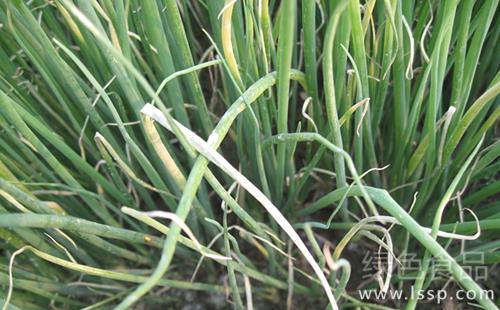
Welsh onion late blight
Welsh onion late blight damages the leaves and flower stalks. In the early stage of leaf infection, inconspicuous pale greenish-white spots appear, which later expand into grayish-white patches that spread lengthwise along the leaf, becoming elongated white lesions whose width exceeds half or even more of the leaf tube circumference; this causes the leaves to become top-heavy and wither; during continuous rainy weather, white cottony mold grows on the diseased areas; in dry weather, the white growth disappears. When the diseased leaf is torn open, cottony white mycelium can still be seen on the inner side of the leaf tube.
The disease is caused by a fungus called Phytophthora nicotianae, a highly virulent and destructive infectious disease. The pathogen overwinters as spores or mycelium in the diseased residues of Welsh onion. In warm winters, the pathogen can infect year-round, and onion sets can also carry the pathogen; the spores spread through rain, wind and airflow. After germination, the spores produce germ tubes that penetrate the leaf epidermis and directly invade the host. Under high temperature and high humidity, Welsh onion becomes diseased quickly and produces spores, spreading rapidly and expanding the damage. 25—32°C is most favorable for disease development. High temperature and high humidity with continuous rain make the disease prone to epidemics; high planting density and low-lying fields with standing water both favor disease development; excessive application of chemical fertilizers with an overemphasis on nitrogen fertilizer makes Welsh onion weak and leads to more severe disease.
To control Welsh onion late blight: first, choose a planting site with good drainage, prepare the land with high beds and deep furrows, drain rainwater promptly to reduce field humidity; thoroughly remove diseased Welsh onion residues from the field; rotate with non-onion and non-garlic vegetables; fertilize rationally, increase phosphorus and potassium fertilizer, and avoid over-applying nitrogen fertilizer. Applying plant ash also helps improve disease resistance. Once an outbreak is found, carry out control promptly and spray the following agents: Shuangjin (60% dimethomorph-mancozeb wettable powder) at 800—1000 times, Tiankemengxin (60% wettable powder) at 700—800 times, Shuanglusujing (72% wettable powder) at 1000—1200 times, Kameitong (64% wettable powder) at 700—800 times, and Ruidumei (58% wettable powder) at 500—600 times, preferably spraying once every 7 days for 2—3 consecutive applications. In addition, Baikening (40% suspension concentrate), aluminum ethylphosphonate-mancozeb (70% wettable powder), Jiadaning and other agents have good control effects on Welsh onion late blight.