Pear guava bears flowers and fruit year-round with good returns, and autumn management is the key
In autumn and winter, with drought and little rain, unpredictable cold and heat, and frequent frost, guava growth is unfavorable, so appropriate methods must be used to create a favorable environment for guava to grow normally. After many years of practice, fruit growers have drawn the following experience:
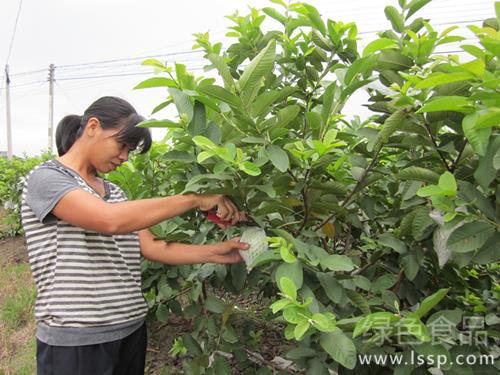
Guava harvest
1. Properly suppress growth and use chemicals to promote flowering: Guava grows quickly under high temperature and high humidity in summer, and most plants have lush branches and leaves with vigorous shoots. After entering August, the flowering node position of guava rises. Based on the fruiting node positions of guava, most are at the 2nd, 4th, and 8th nodes, but there are also a small number of flowers at the 8th—12th nodes. In addition, many branches are all water sprouts, and the fruit-setting rate is not high. After spraying B9 (daminozide) at 1000-2000 ppm in late August, the number of flowers increases sharply. At the same time, pinching can be combined, pinching at the 5th or 9th node to promote flower formation at the 4th or 8th node. After taking measures, the number of flowers is often 1-2 times more than without treatment, and these flowers set fruit easily. However, when using chemicals to promote flowering, the chemicals differ depending on the season. After entering November, the weather turns cold, so switch to chlormequat to promote flowering and preserve flowers, which can effectively prevent small flowers from cold damage. When using chlormequat, borax should be used together. Chlormequat easily increases the bitterness of guava, but using it with borax can reduce bitterness and increase sweetness.
2. Pest and disease control: The main pest and disease of guava in autumn and winter is anthracnose, which can be controlled with 70% thiophanate-methyl wettable powder or 75% chlorothalonil 800 times solution. The main pests include aphids, scale insects, and tussock moths, which can be controlled with 24% DuPont Lamate liquid 1000 times solution. If mealybugs damage young shoots, the young shoots will turn black, shrink, and find it difficult to grow flowers. In addition, because pest generations overlap, chemicals must be applied continuously. Lufu, Kuailing, and others have obvious insecticidal effects. During autumn and winter droughts, root-knot nematodes easily occur, and in severe cases, guava orchards become barren in patches. They mainly cause old leaves to turn purple, gradually turn red, and finally die, from bottom to top, leaving bare branches. If not controlled in time, surrounding plants will also show similar symptoms. Therefore, in autumn and winter, as soon as scattered diseased plants are found, chemicals must be applied in time. Use soil insecticide mixed with fine sand and broadcast it; when broadcasting, the surface soil of the tree should be dug open and the soil mixed evenly to control its spread.
3. Rational use of foliar fertilizer: In autumn and winter, targeted use of foliar fertilizer gives better results. Using 3% urea mixed with 1% superphosphate can increase guava yield. Using 0.2% borax mixed with 0.5% potassium dihydrogen phosphate can promote fruit setting and increase sweetness. Because autumn and winter have insufficient sunlight, reduced photosynthesis, and multiple fruitings, the flavor of guava becomes bland, so more farmyard manure should be applied, along with foliar fertilizer.