Many causes of weak winter wheat seedlings, and how to manage them according to the symptoms
1. Dry soil:This mostly occurs in wheat fields with insufficient subsoil moisture or where moisture escapes through cracks in the soil. Tillering is slow to emerge, leaf color is grayish green, the central leaf is short and small, growth is slow or stalled (also called "shriveled-heart seedlings"), the middle and lower leaves gradually turn yellow and dry up, and the roots are few and thin. Key management points: along with watering, apply 15 kg of ammonium bicarbonate per mu.
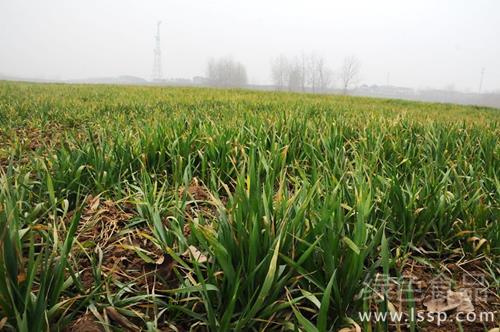
Wheat seedling condition
2. Soil nitrogen deficiency:The seedlings are thin and weak, standing upright, with reduced tillering and narrow, short leaves. The lower leaves of the wheat gradually turn yellow and dry up starting from the leaf tips, then spread to the upper leaves. Key management points: use 7 to 8 kg of urea per mu, or 20 to 25 kg of ammonium bicarbonate, applied in furrows between rows or watered on with water.
3. Soil phosphorus deficiency:In weak wheat seedlings, root development is poor, with few and weak secondary roots; leaf color is dark green and lusterless; leaf tips and leaf sheaths are purplish red; the plants are thin and small, with reduced tillering. Key management points: along with watering and hoeing, apply 20 to 30 kg of superphosphate per mu, placed in furrows between rows.
4. Waterlogged, compacted, or saline-alkali soil:The wheat seedling root system develops poorly and has weak absorption capacity; tillering is slow to emerge and is accompanied by fertilizer-deficiency symptoms. Where saline-alkali damage is severe, patches of purplish red "little old seedlings" appear, and the basal 1 to 2 leaves of the seedlings turn yellow and dry up; in severe cases, the seedlings die in patches. Key management points: along with deep intertillage, open furrows and apply a mixed nitrogen-phosphorus fertilizer; where saline-alkali damage is severe, after topdressing, irrigate to leach salts, and hoe to loosen the soil and break up crusting.
5. Hard, compacted soil:Lacking moisture and air, roots have difficulty extending, causing wheat leaves to be yellow and short and tillers to fail to appear on time. Key management points: first water promptly, then carry out deep intertillage to loosen the soil and break up the hardpan.
6. Soil too wet:Weak seedlings have pale purple leaves, tillering is slow to emerge, and in severe cases the leaf tips turn white and dry up. Key management points: first carry out timely deep intertillage to reduce moisture and improve aeration, then topdress with a small amount of quick-acting fertilizer to encourage early seedling growth.
7. Seeding rate too high:The seedlings are overcrowded, and the plants are thin and weak, slender. Key management points: first promptly thin the seedlings, especially the "clumped seedlings" at field edges, borders, and within the field; thin early and thin severely, then along with watering, topdress with a small amount of quick-acting nitrogen and phosphorus fertilizer to make up for nutrients excessively consumed by the soil and help the wheat seedlings shift from weak to strong.
8. Sowing too deep:Emergence is slow, the leaf sheaths are slender and long, tillering is delayed, and secondary roots do not grow. Key management points: first scrape away soil to expose the crown, then promptly topdress (apply 15 kg of ammonium bicarbonate per mu) to promote root system and seedling development of the wheat.
9. Sowing too shallow:In weak seedlings, the tillering nodes are close to the ground, water and nutrients are poor, and root growth and tiller bud development are inhibited; because roots and tillers are reduced, the plants are yellow and weak and prone to freezing and dying. Key management points: along with hoeing, mound soil around the roots; when aboveground growth of the wheat pauses, break the ridges and cover with soil. The soil cover thickness should be such that the tillering nodes are about 3 cm below the soil surface; if using outside soil for covering, cover sand with clay or cover clay with sandy soil, which can also improve the soil.
10. Sowing too late:Because the pre-winter growth period is short and accumulated temperature is insufficient, wheat growth is thin and weak, with few tillers. Key management points: focus on hoeing and supplemental fertilizer and water; at the three-leaf stage, apply 15 kg of ammonium bicarbonate per mu; for wheat fields with poor soil moisture and rapid water infiltration, irrigate tillering water promptly after the three-leaf stage (but for plots with suitable moisture or heavy, sticky soil with poor water permeability, do not water before winter); carry out the last hoeing before the soil freezes.