Control Methods for Chinese Cabbage Viral Disease: Leaf Curling, Brittle Texture, and Distorted Heart Leaves
Chinese cabbage viral disease, also known as guding disease, severely threatens Chinese cabbage production. After Chinese cabbage is affected by viral disease, its low disease resistance makes it most susceptible to concurrent downy mildew and soft rot.
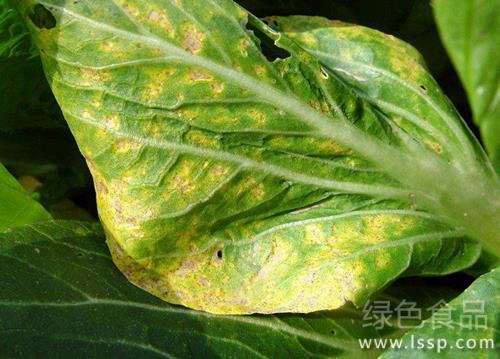
Chinese Cabbage Viral Disease
1. Symptoms:
In the early stages of seedling disease, clear veins appear in the heart leaves, and chlorosis develops along the leaf veins, gradually turning into a mosaic of light green and dark green. The diseased leaves become wrinkled and uneven, brittle in texture, and the heart leaves become distorted and deformed. In some Chinese cabbage plants, brown necrotic spots or streak lesions form on the main and lateral veins on the underside of the leaves, and the petioles curl to one side. When disease occurs at the mature plant stage, the leaves also show seedling symptoms. Severely affected Chinese cabbage becomes stunted, fails to form a head, and stops growing. The root system is poorly developed with few fibrous roots, and when the root is cut open, the cut surface is visibly brown. In infected seed plants of Chinese cabbage, the flowering bolts emerge late, are short and curved, with small and hard leaves. New leaves show clear veins or chlorosis along the veins, the main veins of old leaves become necrotic, and the flower stalks have longitudinal and transverse cracks. The seed pods are thin, small, and curved, with shriveled seeds and low germination rates. In severely affected plants, the seed plant dies before the flowering bolt has even emerged.
2. Pathogen and Disease Occurrence Patterns
(1) Pathogen. Chinese cabbage viral disease is caused by infection from one or several viruses, either alone or in combination, such as turnip mosaic virus, cucumber mosaic virus, tobacco mosaic virus, and radish mosaic virus. (2) Infection cycle. The virus mainly overwinters on Chinese cabbage seed plants infected in late autumn or on stored Chinese cabbage in cellars. The following year, aphids or other virus-transmitting vectors carry the virus from the overwintering Chinese cabbage to spring-sown pak choi, and from these vegetables it spreads to autumn-sown Chinese cabbage. (3) Disease conditions. From seedling emergence to the rosette stage of Chinese cabbage, if there is little rainfall and conditions are hot and dry, the disease occurs severely. In addition, extensive management, insufficient base fertilizer, too little watering, delayed thinning, and poor growth can all cause the disease to occur and spread.
3. Control Methods
(1) Select disease-resistant varieties. Green-stemmed Chinese cabbage is more disease-resistant than white-stemmed types, and late-maturing varieties are more disease-resistant than early-maturing ones.
(2) Select and retain disease-free seed plants. For seed production, select disease-free plants from disease-free fields, and when planting seed plants, choose disease-free ones.
(3) Sow at the appropriate time, slightly late. Sow 3 days before or 5 days after the Beginning of Autumn. In rainy years, sow early at the appropriate time; in dry years, use short-growing-season Chinese cabbage varieties and sow late at the appropriate time.
(4) Strengthen field management. Deep plow and cultivate carefully, apply sufficient fully decomposed farmyard manure, increase phosphorus and potassium fertilizer, remove weeds in and around the field, keep the garden clean, and reduce the initial infection sources of the virus and virus-transmitting vectors. Along with thinning, remove weak and diseased seedlings, water reasonably, and during hot and dry conditions, increase watering frequency to lower soil temperature and prevent viral disease.
(5) Control aphids and virus-transmitting vectors. Spray with 50% pirimicarb wettable powder at 3000 times dilution. Spray with 10% imidacloprid wettable powder at 1000-2000 times dilution.
(6) Chemical control. In the early stages of Chinese cabbage viral disease, spray with 20% Virus A wettable powder at 500 times dilution, or 1.5% zhibingling emulsion at 1000 times dilution, or 83 anti-resistance agent at 100 times dilution, spraying once every 7-10 days for 2-3 consecutive sprays.