Brown leaf spots with halos on napa cabbage? Black spot disease control methods
Napa cabbage black spot disease is a fungal disease. On affected napa cabbage leaves, nearly round brown or light brown spots 2 to 10 mm in diameter appear, surrounded by halos, with obvious concentric rings on them. When humidity is high, black mold-like growth (the pathogen) forms on the spots on the underside of the leaves and can spread to other napa cabbage plants via airflow. In severe cases, the spots on the leaves join together, causing the leaves to turn yellow and die from the outside inward. The control measures are as follows:
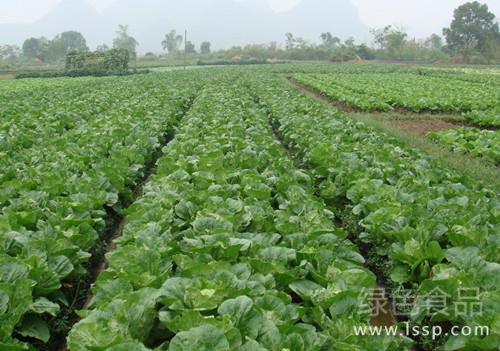
Napa cabbage
1. Seed treatment:The black spot disease pathogen can attach to napa cabbage seeds and directly infect seedlings. Therefore, before sowing napa cabbage, seed can be dressed with 50% thiram wettable powder at 0.4% of seed weight, or with 50% iprodione wettable powder at 0.2% to 0.3% of seed weight.
2. Control field humidity:During the susceptible period, high field humidity leads to severe disease. ① Thin seedlings at the right time. According to factors such as napa cabbage variety characteristics and soil fertility, thin seedlings at the right time and with appropriate plant spacing to improve field ventilation. ② Water rationally. During the susceptible period, "watch the sky, watch the soil, and watch the growth of the napa cabbage," and water by bed at the right time and in the right amount. Avoid watering followed by rainfall. Drain standing water in the field as early as possible.
3. Spray early:After the black spot disease pathogen invades napa cabbage leaves, spots can form in 3 to 5 days, and black mold-like growth can form on the spots and invade the napa cabbage again. Therefore, when spots appear on the lower leaves of napa cabbage, spraying can begin. Use 75% chlorothalonil wettable powder at 600 times dilution, or 50% iprodione wettable powder at 1500 times dilution, or 50% thiram wettable powder at 500 times dilution, or 64% oxadixyl-mancozeb wettable powder at 500 times dilution. Spray once every 7 to 10 days, for 3 to 5 consecutive sprays, using 50 kg of spray solution per mu each time.
4. Foliar fertilizer supplementation:If the napa cabbage is growing weakly, in addition to strengthening water and fertilizer management, 0.2% potassium dihydrogen phosphate or 1% brown (white) sugar can be added to the spray solution to supplement foliar nutrition.
5. Precautions:① Fields prone to the disease. Fields with continuous or adjacent cropping to cruciferous vegetables, fields sown without seed treatment, fields sown too early, fields with high napa cabbage density, fields with insufficient basal and topdressing fertilizer, fields where napa cabbage grows weakly, and fields irrigated by flooding are prone to the disease. ② Vegetables susceptible to damage. In addition to napa cabbage, radish, cabbage, rapeseed (bok choy or green cabbage), and cauliflower are also susceptible to infection by this disease, and control measures can refer to those for napa cabbage.