There are many causes of pepper fruit rot, so how do you treat it in a targeted way?
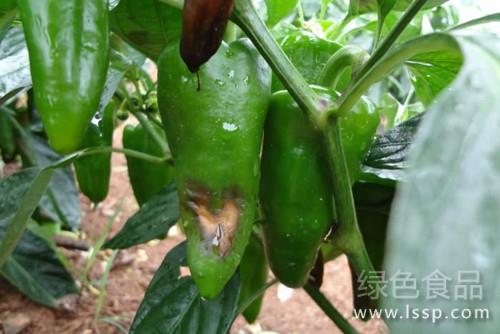
Pepper fruit rot
1. Pepper Phytophthora blight: Stem lesions mostly occur at the branching points, first appearing as water-soaked spots, dark green, then turning blackish brown, with the cortex soft-rotting; the branches and leaves above the diseased area wilt and die, and in humid conditions white mold grows on the diseased area. Pepper fruit infection mostly starts from the blossom end, with water-soaked lesions spreading over the fruit surface, resembling scalding, grayish green, then turning gray and soft-rotting, with sparse white mold. After transplanting and at the beginning of flowering, use 50% copper succinate 500x solution and 72.2% Previcur water agent 600x solution, or 64% Sandofan 500x solution, or 72% DuPont Curzate 700x solution, or 58% metalaxyl-mancozeb 700x solution for control.
2. Pepper Sclerotinia rot: Infected pepper fruit generally starts from the fruit surface at the navel and spreads toward the stem end, first turning brown, sometimes with light brown concentric rings; white mycelium grows on the lesions, and then part or all of the tissue rots brown. In the early stage of the disease, spray 50% thiophanate-methyl wettable powder 500x solution, or 40% dimethachlon wettable powder 1000x solution, once every 7-10 days, for 2-3 consecutive sprays. In greenhouses, 10% sec-butylamine smoke agent and 45% chlorothalonil smoke agent can be used for fumigation, at 250-300 g per mu, once every 7 days, for 2-3 consecutive fumigations.
3. Pepper anthracnose: It mainly damages the fruit. In the early stage of the disease, use 80% Xinwansheng 1000x solution, or 80% anthracnose Fumei 800x solution, or 50% carbendazim 600x solution, or 70% thiophanate-methyl 800x solution for control.
4. Pepper bacterial soft rot: It mostly occurs near the fruit stalk, with small water-soaked dark green lesions first appearing around the calyx tube, spreading rapidly, turning the whole fruit green, soft-rotting, with the internal tissue decaying, and the diseased fruit appearing blistered. After the peel splits, the internal liquid flows out, leaving only a shrunken skin. Control: Use 72% agricultural streptomycin 4000x solution or DT bactericide 500x solution, spraying once every 7 days, for 2-3 consecutive sprays.
5. Pepper gray mold: It mostly starts from the fruit stem end, with the peel turning grayish white and becoming water-soaked and soft-rotting. The lesions quickly spread to half or the whole fruit, and are densely covered with grayish white or grayish brown mold. In the early stage of the disease, spray 50% Shukeling 1500-2000x solution, or 50% carbendazim 500x solution, or 70% mancozeb 500x solution, or 70% thiophanate-methyl 1000x solution. Spray once every 7 days, for 2-3 consecutive sprays.
6. Pepper blossom-end rot: A physiological disease, mostly caused by calcium deficiency due to abnormal water supply. In the early stage of the disease at the navel of the pepper fruit, dark green water-soaked lesions appear, then expand, shrink, become sunken, and turn brown, often turning black or rotting due to secondary infection by other pathogens. In the early stage of the disease, spray 1% calcium superphosphate or 0.1% calcium chloride, once every 7 days, for 2-3 consecutive sprays.