Deep plowing and soil ripening method for apricot trees to improve and condition the soil; deep plowing can improve soil aeration and water permeability.
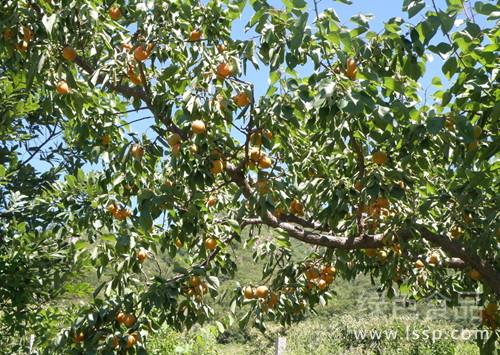
Apricot tree
1. Soil management: Good soil management can make apricot orchard soil loose with good aeration and active soil microorganisms, ensuring that apricot tree roots develop in a suitable environment. A strong root system is the foundation and guarantee for apricot trees to absorb water and nutrients. Only with a strong root system and well-developed absorbing roots can the aboveground growth and development have a nutritional foundation. Therefore, improving the soil management level of apricot orchards is the prerequisite for obtaining high and premium yields.
2. Deep plowing and ripening: The main method of soil improvement is deep plowing and ripening. In apricot orchards, deep plowing and ripening, combined with increased application of organic fertilizer, deepens the active soil layer, improves soil fertility, improves soil physical and chemical properties, promotes nutrient transformation, enhances microbial activity, accelerates soil ripening, and eliminates unfavorable soil factors. Deep plowing can increase soil porosity, enhance soil water and fertilizer retention capacity, and improve aeration and water permeability. Deep plowing combined with organic fertilizer application can increase and activate soil microorganisms, thereby accelerating the decomposition and breakdown of organic matter and improving soil fertility. Deep plowing can also deepen the root distribution layer, which helps increase root quantity. This is especially true for barren mountainous land, sandy land, or clay land with a soil layer of less than 50 cm, where the ripening and improvement effects are more obvious.
3. Timely deep plowing: Deep plowing in apricot orchards can be carried out after thawing in early spring and before the rainy season in early summer, but the most suitable time is after fruit harvest, carried out simultaneously with autumn base fertilizer application and water storage irrigation. Deep plowing at this time allows root wounds to heal easily and new roots to emerge readily, which is beneficial to the growth and development of apricot trees the following year. At the same time, after deep plowing, the long winter is beneficial for soil weathering and water storage and moisture conservation.
4. Plowing depth: If the soil texture is good and the root system is well-developed and grows deeper, plowing should also be deeper; otherwise, it should be shallower. Heavy clay soil should be plowed deep, sandy soil should be plowed shallow; where the groundwater level is low, plowing should be deep; where the groundwater level is high, plowing should be shallow.
5. Deep plowing methods:
① Whole-orchard deep plowing. Deep plow all the soil outside the planting holes at one time. Suitable for plains, riverbank land, and gently sloping land. This method requires more labor at one time, but after plowing it is easy to level the land, which is beneficial for orchard cultivation.
② Expanded-hole deep plowing. During the young tree stage, according to the extent of root growth, expand the holes outward year by year from the planting holes for deep plowing. Expanded-hole deep plowing should connect with the previous deep plowing trench, leaving no partition in between, until all the soil between and within the rows has been plowed.
③ Alternate-row deep plowing. Carried out between rows and within rows; when young apricot trees begin fruiting, their roots are close to filling the entire orchard, so plow one row and skip one row, rotating year by year. In this way, only one side of the root system is damaged each time, having little impact on apricot tree growth and fruiting. However, for alternate-row deep plowing, the trench should be at least 1 m from the trunk on both sides.
6. Precautions:
1. Carefully protect roots: When deep plowing by hand, pile topsoil and subsoil separately, and injure roots as little as possible. In particular, lateral roots larger than 1 cm must not be cut or damaged, otherwise apricot trees will temporarily grow slowly or stop growing; however, fine roots smaller than 1 cm heal easily after being cut and produce many new roots. The roots dug out should be protected and must not be exposed to drought, sun, or freezing, and the wound surfaces of large cut roots should be trimmed smooth in time.
2. Combine with fertilizer application: When backfilling, first fill in topsoil and the surface mature soil around the trench, and at the same time apply large amounts of organic fertilizers such as barnyard manure, compost, green manure, green grass, and straw. Generally, for every 1 cubic meter of soil turned, 20-40 kg of organic farmyard manure should be applied; in addition, phosphate fertilizer should be mixed in. Organic fertilizer should be mixed evenly with the soil, and branches and other materials that do not rot easily should be placed at the bottom of the trench.
3. Fill soil and water, and do not backfill subsoil into the trench. When the trench is nearly full, spread the subsoil level on the ground so that it can ripen. After filling and leveling the soil, strive to irrigate thoroughly so that the apricot tree roots closely contact the soil and quickly resume growth.