Control Methods for Root Rot, Lettuce Lodging, and Lettuce Soft Rot
Lettuce Soft Rot
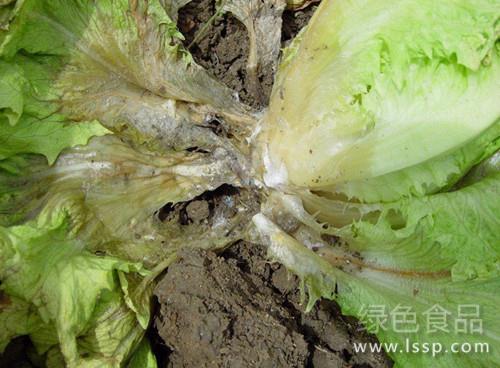
I. Damage symptoms: Lettuce soft rot caused by Sclerotinia minor includes two types: root rot and stem base rot. Root rot type: After the lettuce roots are infected by Sclerotinia minor, white mycelium appears at the stem base, gradually forming large numbers of small white particles, on which water droplets exude; the small particles later turn into black sclerotia, and sometimes many sclerotia merge into blocks, causing root rot. Stem base rot type: It mainly infects the stem base, causing lesions at the stem base; when young lettuce is infected, the mycelium from the lower part spreads upward rapidly, and the diseased plant rapidly develops soft rot and lodges.
II. Transmission routes and disease conditions: The pathogen's sclerotia attach to lettuce to overwinter or oversummer; the following spring the sclerotia germinate into new mycelium, which invades from the lettuce roots or stem base and gradually spreads upward to the aboveground parts. After diseased plants lodge, the disease is also transmitted through contact between diseased and healthy plants. During disease spread, the mycelium produces large numbers of sclerotia; due to plowing and turning of the soil, the sclerotia fall into the soil and become the primary infection source for the following year.
III. Control methods:
(1) Practice paddy-upland rotation, or rotate with other vegetables.
(2) According to foreign reports, Trichoderma harzianum can effectively suppress sclerotinia disease and can be demonstrated and promoted.
(3) Select disease-resistant varieties, such as red-leaf lettuce, Guasihong, Hongpi Yuanye and other varieties with red coloration and resistance to sclerotinia disease, as well as head lettuce, such as Wanli Butterhead Lettuce and Shuangsui Butterhead Lettuce, which can also resist Sclerotinia minor.
(4) Cultivate age-appropriate strong seedlings; a seedling age of 6 to 8 true leaves is suitable.
(5) It is recommended to apply compost fermented with Japanese enzyme bacteria, or apply 7.5 to 10 kg of phosphate fertilizer and 10 to 15 kg of potassium fertilizer per mu. Begin topdressing after the lettuce starts to open up; you can also spray 0.2% to 0.5% compound fertilizer or spray 6000-fold Zhibaosu solution to improve the lettuce's disease resistance.
(6) Transplant with soil, improve the quality of film covering, make the film fit tightly against the ground, and avoid weed growth.
(7) Cover with black plastic film at the appropriate time to block apothecia emerging from the soil under the film, so that they cannot receive sufficient scattered light and cannot complete their development process, greatly reducing the probability of primary infection. Remove diseased leaves in time, pull out diseased plants and bury them deeply, and combine this with chemical control. However, during high-temperature periods, guard against plastic film absorbing heat and scorching seedlings; when necessary, spread a layer of fine soil on the film, or water to lower the temperature, or delay the transplanting period to avoid high-temperature damage.
(8) At the early stage of disease onset, begin spraying 50% thiophanate-methyl sulfur suspension concentrate at 700-fold dilution, or 50% iprodione wettable powder at 1000-fold dilution, 50% procymidone or vinclozolin wettable powder at 1500-fold dilution, 40% dimethachlon wettable powder at 500-fold dilution, or 20% tolclofos-methyl emulsifiable concentrate at 1000-fold dilution. Apply once every 7 to 10 days, for 3 to 4 consecutive treatments.
(9) For lettuce cultivated in greenhouses, smoke method or dust method can be used; stop applying chemicals 3 days before harvest.