Method for promoting rapid growth of peanuts through clearing the seedlings, root-restricting to strengthen seedlings, pressing rings, and spreading soil and fertilizer
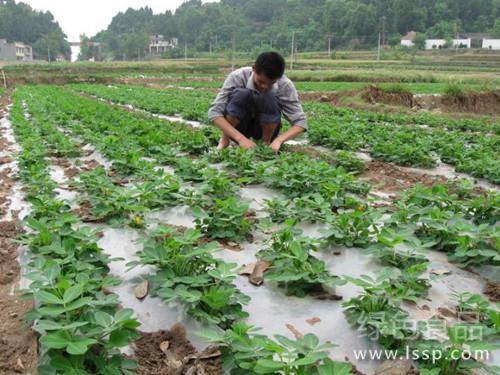
Peanut field management
1. Clearing the seedlings and root-restricting to strengthen seedlings: After the seedlings emerge, scrape away the soil around the base of the peanut seedlings to expose the two cotyledons. This promotes the early development of the first pair of lateral branches, shortens the internodes of the stem, achieves strong seedlings, and advances flower bud differentiation, which is conducive to high yield. According to experiments: clearing the seedlings and root-restricting to strengthen seedlings increases yield by about 10%-20% compared with not doing so. Clearing the seedlings requires good timing and depth. When the seedlings are basically uniform and two true leaves are visible on the main stem, carry out the clearing; too early and the seedlings are tender with weak resistance; too late and the lateral branches are thin and weak, failing to achieve the purpose of clearing. The depth should be such that the two cotyledons are exposed above the soil surface; too shallow and the first pair of lateral branches remain in the soil, failing to achieve the effect; too deep and the embryo buds are easily scraped out, causing the seedlings to lodge, which is detrimental to growth. Only 15 days after clearing the seedlings can intertillage and loosening of the soil be carried out.
2. Pressing rings around the whole plant: At the beginning of the flowering stage, in combination with hoeing and clearing the seedlings, soil, preferably wet soil, is pressed on the base of the peanut plants so that each hill of peanut plants grows directionally in three directions, slanting toward the ground surface. Before and after the peanut rows close and at the beginning of the flowering stage, a ring about 30cm in diameter is placed and pressed over the middle of each hill of peanuts, so that the peanuts creep along the ground in three different directions. In this way, compared with conventional cultivation, diseases are reduced. The branches grow well, the fruiting range is enlarged, and peanut yield can be increased by about 10%-15%.
3. Timely soil spreading: When a large number of pegs are entering the soil, a few pegs cannot enter the soil, and some pegs stop growing as soon as they touch the soil. At this time, fine wet soil is scooped up on the spot and scattered down from the top, which can increase the peg soil-entry rate, the pod-setting rate, and the full-pod rate. According to experiments: after the full flowering stage, timely soil spreading can increase yield by more than 5 kg per mu.
4. Topdressing calcium fertilizer: During the pod-setting stage, peanuts need large amounts of calcium and phosphorus. Applying gypsum and superphosphate is beneficial to shell formation, increases the full-pod rate, and raises the oil content of the seeds. The method is: after the pegs enter the soil, in combination with irrigation, for alkaline soil apply 5-15 kg of gypsum per mu, and for neutral soil apply superphosphate. If a 2% superphosphate solution is also used for foliar spraying, the effect is even better.
5. Increasing the application of boron fertilizer and molybdenum fertilizer: Practice has proved that applying boron fertilizer and molybdenum fertilizer to peanuts can increase yield by more than 10%. Application method: at the early flowering stage, use 50-60 kg per mu of 0.3% borax solution for foliar spraying; during the growth period, use 50 kg per mu of 0.15% ammonium molybdate solution for foliar spraying.
6. Disease prevention: In the middle and late stages of peanut growth, plants are susceptible to leaf spot disease and peanut rust, which must be controlled in time.