Apple brown spot disease causes leaf drop; how should it be controlled after rain?
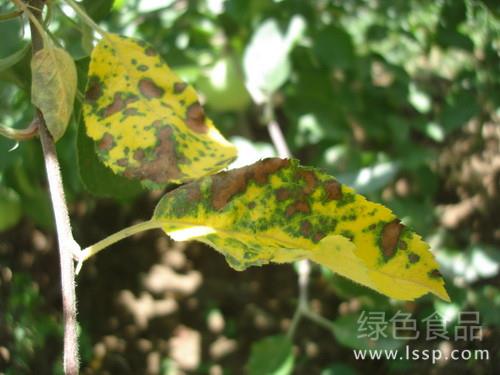
Apple brown spot disease
I. Occurrence characteristics of brown spot disease:
Apple brown spot disease is a fungal disease. The pathogen is Marssonina coronaria. High temperature and high humidity are the conditions for its occurrence. It can occur at 5-30°C, with 20-25°C being most suitable. The incubation period of the pathogen varies with temperature: at low temperatures the incubation period is longer, while at high temperatures it is shorter. When relative humidity is above 80%, the disease is more likely to occur.Apple brown spot disease mainly damages leaves, causing early leaf drop in apples. The season for brown spot disease is coming again soon, and it is hoped that the majority of fruit growers will do a good job in controlling brown spot disease.
II. The problem of leaf drop
1. Effect on flower bud differentiation: Leaves are the main source of nutrients. In summer, the nutrients produced by leaves are mainly supplied for apple fruit expansion and flower bud differentiation. Once the leaves are infected, they drop in large numbers, nutrient supply decreases, flower bud differentiation is incomplete, and the flowering potential in the following year is not strong, directly affecting flowering and fruit set.
2. Effect on the apples: When leaves are infected and drop in large numbers, nutrient production cannot keep up, which also has a great impact on the growth of the apples in that year. The apples become smaller, dry matter decreases, weight is lighter, the peel is rough, and the color is dull, affecting the marketable rate.
3. Effect on tree vigor: In June and July, apple trees are in the critical period of apple expansion and flower bud differentiation. If a large number of leaves drop, the leaves cannot produce sufficient nutrients, so during the process of apple expansion and flower bud differentiation, the tree's own nutrients must be consumed, "eating into next year's grain," which is very unfavorable for the recovery of tree vigor and easily leads to valsa canker.
III. Causes of brown spot disease:
1. Untimely medication: Brown spot disease generally begins to infect from late May to early June, so it should be controlled in time before and after apple bagging.
2. Poor quality of chemicals: Many products for controlling brown spot disease, such as tebuconazole, are of poor quality, have insufficient content, or for other reasons have low utilization rates, resulting in insufficient dosage during application and failure to achieve the control effect; on the other hand, when fruit growers spray, the amount of water used is insufficient and the spraying is not thorough, especially the spraying amount in the inner canopy of the fruit tree is insufficient, leading to brown spot disease.
3. Improper fertilization: Applying too much nitrogen fertilizer leads to deficiency and insufficiency of phosphorus and potassium fertilizers and medium and trace element fertilizers, causing excessive vegetative growth of the fruit tree and the formation of a "false fat tree," reducing the disease resistance of the apple tree.
4. Inadequate orchard management: Improper pruning of the orchard, too many branches, and a relatively closed orchard with poor ventilation and light penetration; orchards in low-lying areas with poor drainage are also prone to brown spot disease.
IV. Control of brown spot disease:
First, strengthen orchard management to improve ventilation and light penetration in the apple orchard; second, after rain, drain water from low-lying areas in time and try not to let the orchard accumulate water for too long; third, apply more phosphorus and potassium fertilizers and organic fertilizers, balance fertilization, and do not apply too much nitrogen fertilizer; fourth, carry out chemical control in time. Chemical control: 430 g/L tebuconazole 3000-4000 times + 70% thiophanate-methyl 600-800 times. Spraying should be thorough and meticulous, with the inside and outside of the canopy, top and bottom, and both sides of the leaves uniformly covered by the spray. While spraying fungicides, mix in appropriate insecticides to control Lithocolletis ringoniella, red spider mites, peach fruit borer, and others.