How to prevent bolting, root cracking and green tops in carrots
When growing carrots, problems such as root cracking, severe premature bolting and green tops often occur, seriously affecting the yield and quality of carrots. The causes and preventive measures for these abnormal conditions in carrots are described below.
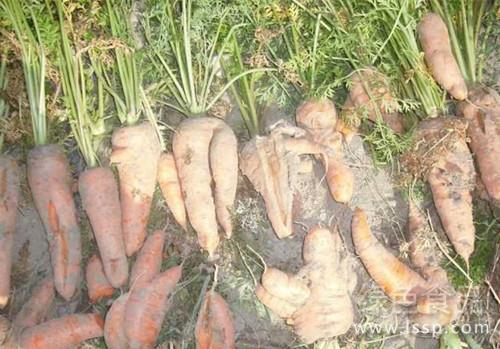
Abnormal conditions in carrots
Premature bolting: after early bolting occurs in carrots, the fleshy root becomes hard and loses its edible value. Main cause: exposure to low temperatures for a certain period after sowing causes the carrot to pass through vernalization and bolt early. According to some data, carrots with generally 7 leaves can pass through the vernalization stage after 25-30 days at low temperatures of 4.5-15°C, leading to bolting and flowering before harvest. In pursuit of an earlier market launch, sowing is often blindly advanced, causing carrots to pass through vernalization early. To prevent premature bolting in carrots, choose varieties resistant to bolting and arrange the sowing period reasonably. In addition, lack of water, insufficient nitrogen supply and severe pests and diseases can all cause premature bolting in carrots, so water and fertilizer management and pest and disease control should be strengthened during the carrot growing period.
Root cracking: improper water management. During the fleshy root swelling stage of carrots, if watering is uneven, with insufficient water supply in the early stage, the fleshy root grows slowly; then in the later stage, heavy rainfall over a short period or a sudden large amount of watering causes the root system to absorb water, and the interior expands rapidly and cracks. For this reason, during the fleshy root swelling stage of carrots, attention should be paid to water management so that the soil alternates between dry and moist. Where drip irrigation or sprinkler irrigation is available, a light watering can be given before heavy rain arrives. In addition, delayed harvesting can also cause root cracking, so in production, harvesting should be carried out when the fleshy root is 18-20 cm long and 3-4 cm thick.
Green tops: the covering soil is too shallow, and no attention is paid to earthing up during the fleshy root swelling process, causing the top of the fleshy root to be exposed above the soil surface. Under sunlight, chlorophyll is produced, turning it green. In carrot fields planted with single rows on small ridges or double rows on large ridges, after removing the plastic film, soil should be earthed up in time. In the early stage, do not cover with too much soil; just enough to cover the top of the carrot. As the carrot grows, the top of the fleshy root will be exposed above the ground, and soil can be earthed up again 3 weeks before harvest. This can prevent the top of the fleshy root from being exposed to light and forming green tops, and can also allow the green top area formed after exposure to light to gradually return to normal.