Solar Greenhouse Cultivation Technique for Intercropping Cucumber with Agaricus bisporus
I. Composting Technique. For 100 sq m, you need 1500 kg of wheat straw, 1250 kg of cow manure, 40 kg of phosphate fertilizer, 40 kg of gypsum, and 50 kg of lime with a pH of 7.5-8. 1. Pre-wetting the wheat straw: Take the wheat straw according to the formula, soak it in water in batches, and once the wheat straw has evenly absorbed water, pile it in layers on one side of the composting yard. 2. Wheat straw...
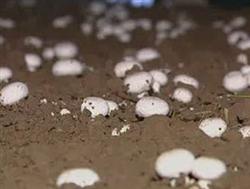 To increase the income of the solar greenhouse, a three-dimensional planting experiment combining vegetables and Agaricus bisporus was carried out. From October 2003 to May 2006, in a 420 sq m greenhouse, without affecting vegetable cultivation, 200 sq m of Agaricus bisporus was cultivated, increasing net income by more than 6500 yuan.
I. Construction of the Greenhouse
The solar greenhouse is about 60 m long and 7 m wide, built on fertile soil with convenient irrigation and drainage and no water pollution. After the greenhouse is built, apply heavy organic barnyard manure and potassium and phosphorus fertilizers, deep plow and level, and water thoroughly once. Evenly spray every corner with 0.5% dichlorvos and dicofol, then fumigate with 6 kg of sulfur for 3 days to thoroughly kill the miscellaneous bacteria and pests in the greenhouse.
II. Cultivation of Cucumber
Choose densely spined varieties. In early October, after the cucumber seedlings in the seedling bed have grown their first true leaf, graft them onto pumpkin seedlings with fully expanded cotyledons as rootstock, and transplant them into cucumber beds 1.2 m wide that have been watered thoroughly. Two rows per bed, with a row spacing of 40 cm and a plant spacing of 25 cm. After they survive, set up trellises and manage normally.
III. Cultivation of Agaricus bisporus
1. Preparation of the compost
Fermentation of the compost is carried out in early October. For every 100 sq m, prepare 1500 kg of wheat straw, 2000 kg of wet cow manure, 500 kg of chicken manure, 20 kg of urea, 50 kg of superphosphate, and 50 kg each of lime and gypsum powder, mix and ferment, turning the pile 4 times in total, which takes 25 days. Well-fermented compost is coffee-colored, has a fragrant smell, a pH of 7.5, and a moisture content of 65%.
2. Disinfection of the compost
At the end of October, bring the fermented compost into the greenhouse. Before that, spray the compost with an appropriate amount of dicofol and a 400-fold solution of deltamethrin and carbendazim, and let it sit covered for 24 hours. When bringing it into the greenhouse, spread the compost in a wavy shape on both sides of each row of cucumbers, 20 cm on each side, making cultivation beds running north-south. After the compost enters the greenhouse, sow at 1 bottle of spawn per sq m using the broadcast sowing method, and gently press the compost surface flat.
3. Casing soil
About 20 days after sowing, when the mycelium has colonized 2/3 of the compost, apply the casing soil. Before casing, water the reserved irrigation ditch thoroughly once; the next day, dig 7 cm deep and evenly cover the wavy compost surface with soil to a thickness of about 3.5 cm.
4. Mushroom emergence
About 40 days after sowing (mid-December), pinheads begin to form and mushrooms emerge. At this time, the cucumber vines have grown to more than 1 m, creating a good shading environment for Agaricus bisporus and favoring mushroom emergence. When pinheads appear, spray fruiting water continuously for 3 days, each day in the early morning and evening when the temperature is lower, using 400-700 ml/sq m of water each time. Then stop watering for 2 days, then spray quality-preserving water in the same way. Agaricus bisporus and cucumber can be marketed simultaneously before New Year's Day. At this time the temperature is relatively low, which is exactly the off-season for vegetables, so extend the mushroom emergence period as much as possible to let the mycelium fully recuperate and increase the total yield.
IV. Integrated Management
1. Temperature
When Agaricus bisporus is fruiting, the temperature inside the greenhouse should be controlled at 20-30°C during the day and above 10°C at night. When insufficient light on cloudy days causes the room temperature to be relatively low, use electric lights at night to increase light and heat, with one 100-watt bulb every 6 m.
2. Water
The humidity inside the greenhouse should be maintained at 60%-80%. After watering or spraying, if the outside temperature is relatively high, ventilate appropriately. During intercropping, the Agaricus bisporus mycelium can absorb groundwater, so spraying should be reduced by 1/3 compared with ordinary mushroom houses; during fruiting, it is enough for the casing soil to remain moist.
3. Fertilization
Cucumbers should be regularly given additional trace-element fertilizer during watering. After three flushes of Agaricus bisporus, spray 0.2% monopotassium phosphate and 0.5% urea on the cucumber leaf surfaces and the Agaricus bisporus bed surfaces.
4. Pest and disease prevention
During the period when fruiting stops, promptly remove mushroom roots and dead mushrooms, level the compost surface, and spray insecticides and fungicides comprehensively. During the fruiting period, use as few chemicals as possible, especially fungicides, to prevent damage to the mushroom bodies.
Intercropping vegetables with Agaricus bisporus solves the problem of difficulty in fruiting Agaricus bisporus in winter, while also reducing inputs, promoting vegetable growth, and improving greenhouse planting efficiency.