How to prevent and control physiological diseases of button mushrooms during the fruiting period
In button mushroom production, from casing soil onward until fruiting, in addition to routine management, correctly mastering and applying the following four key points on watering plays an important role in ensuring the amount and vitality of mycelium, ensuring the number and uniformity of pinheads, and ensuring the healthy growth of fruiting bodies and their commercial quality. 1. The "mycelium-pressing water" should be...
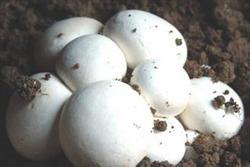 I. Mycelial overgrowth (mycelium running over the casing)
Symptoms are that the mycelium covers the casing surface and cannot lie down in time. Causes: the spawn incubation temperature is too high (above 22°C); poor ventilation in the mushroom shed and high air humidity; the aerial mycelium of the spawn grows too vigorously; the compost is over-fermented and rich in readily available nutrients. Control methods: select semi-intramatrical, semi-aerial type mycelium for inoculation; prevent the medium from being too wet and decomposing too quickly, control temperature and moisture content, and avoid over-fermentation; lower the temperature of the spawn incubation room and keep it at around 22°C; promptly use a knife to break through the mycelial skin of the overgrown mycelium, increase ventilation, lower the relative air humidity, and give a heavy watering to promote timely fruiting.
II. Mycelial clumping
Symptoms are patches of short, dense mycelial clumps appearing on the compost surface or casing layer. Causes: mainly caused by a combination of high temperature in the mushroom shed, over-fermented compost, late casing, and high relative air humidity due to poor ventilation. If the aerial mycelium grows too vigorously, it can also cause mycelial clumping. Control methods: water reasonably, manage the relative air humidity well, and remove the mycelial clumps; fruiting bodies will soon form.
III. Dead mushrooms
Causes: mainly low temperatures in the mushroom shed in winter; dead mushrooms are very likely to occur when the temperature inside the shed stays below 10°C for 12 hours a day. Sometimes excessive humidity in the shed and too much watering after casing also cause it; too large a day-night temperature difference, exceeding 10°C for a long time, also easily causes dead mushrooms. In addition, too dense fruiting, and accidentally loosening the surrounding mycelium when picking mushrooms, which affects the nearby small mushrooms' nutrient uptake, causes some small mushrooms to die; too high a fruiting position, pests and diseases, or pesticide damage can all easily cause dead mushrooms. Control methods: arrange the production season well and strengthen insulation measures for the mushroom shed; increase ventilation and prevent the fruiting position from being too high; control pests, diseases and weed fungi, use pesticides correctly, and be careful not to use pesticides that cause harmful reactions in edible mushroom varieties.
IV. Thin cap disease
Symptoms of this disease are thin caps, slender stipes, and early veil opening. Causes: too high temperature; too dense fruiting; poor ventilation; excessive humidity. Control methods: ventilate to cool down, reduce watering, and lower the relative air humidity.
V. Hard veil-opening disease
Causes: excessive temperature fluctuations; this disease is easily triggered when the temperature difference exceeds 10°C. Control methods: pay attention to insulation and cold protection in autumn, and keep the relative air humidity stable.
VI. Red root or green root disease
Symptoms of this disease are red or green mushroom bases, with normal cap color. Causes: too much watering before fruiting, too much glucose spraying; the compost is acidic; poor ventilation and so on can all cause the disease. Control methods: increase ventilation, avoid watering during high temperatures; when watering and spraying sugar solution, according to the relative air humidity and the wetness of the compost and mushrooms, keep it as far as possible within the range most suitable for fruiting body growth; during the fruiting period the water content of the casing layer should not be too high. Stop watering before picking mushrooms and ventilate appropriately.
VII. Water rust disease
The main symptom of this disease is rust-colored spots on the fruiting bodies, which may even merge into patches. Causes: after the fruiting bodies emerge, the bed surface is watered without timely ventilation, so water droplets on the fruiting bodies do not evaporate in time. Control methods: ventilate appropriately and promptly after watering.
VIII. Flat-topped and hollow-centered mushrooms
The main symptoms of this disease are flat or hollow-centered caps. Causes: mainly insufficient water content in the casing layer above the compost or low relative air humidity, which leads to flat tops, hollow centers, or scales on the surface. Control methods: replenish water in time, and keep the relative air humidity during the fruiting period at 85%-90%.
IX. Deformed mushrooms
The main symptoms of this disease are uneven caps, non-round caps, long stipes, and small caps. Causes: the coarse casing soil particles are too large in diameter and too hard; the carbon dioxide content in the air is too high (above 0.3%). Control methods: the casing soil particles should not be too large; strengthen ventilation and air exchange, place heating stoves outdoors, and use flue heating to reduce the carbon dioxide content in the air.
X. Landmine mushrooms
The main symptom of this disease is soil stuck on top of the cap; it is also called mud-topped mushroom. Causes: the medium is too wet, or soil is mixed into the medium; when watering, the temperature in the mushroom shed is too low and fruiting occurs too early; too much ventilation and the fine soil casing is applied too late. Control methods: the compost should not be too wet, and soil should not be mixed into the compost; after watering adjustment, reduce ventilation and keep the relative air humidity at around 85%; apply the fine soil casing before small mushroom buds have formed on the coarse soil layer, to prevent fruiting too early.