Detailed Explanation of Key Techniques for Cultivating Button Mushrooms (Agaricus bisporus) with Biogas Residue
1. Base material formula: biogas residue 3000 kg, wheat straw or rice straw 3000 kg, superphosphate 120 kg, urea 18 kg, lime powder 180 kg, gypsum powder 90 kg, light calcium carbonate 30 kg, edible mushroom three-dimensional nutrient essence 1440 g (12 bags). This formula is suitable for a cultivation area of 200-220 sq m....
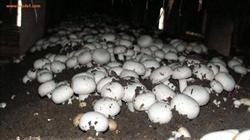
1. Base material formula: biogas residue 3000 kg, wheat straw or rice straw 3000 kg, superphosphate 120 kg, urea 18 kg, lime powder 180 kg, gypsum powder 90 kg, light calcium carbonate 30 kg, edible mushroom three-dimensional nutrient essence 1440 g (12 bags). This formula is suitable for a cultivation area of 200-220 sq m.
2. Base material heap fermentation: Except for the three-dimensional essence, build the wheat straw directly with fresh biogas residue and auxiliary materials into a heap for fermentation, in the manner of one layer of straw material, one layer of biogas residue and auxiliary materials, stacked layer by layer. Generally, the heap is built 1-1.2 m wide and 1.5-2 m high; counting from the day the heap is built, turn it once each when it reaches 6 days, 5 days, 4 days, and 3 days respectively. Method of turning the heap: spray water on the material heap several hours in advance so that the straw material at the edges can fully absorb water. Starting from one end of the material heap, first remove the edge material, use the material from the high-temperature zone inside the heap as the bottom and top of the new material heap, and turn the edge material, bottom material, and top material into the middle position of the new material heap. During the third turning, evenly spray 800-fold phoxim solution into each layer of material, with an amount of about 5S kg per ton of dry material, to kill and drive away pests that have invaded the material heap. During the last turning, evenly spray in the three-dimensional essence.
3. Bed filling and spawning: After fermentation is completed, spread out the material heap, adjust the pH to about 8, and cool it to below 30°C or to room temperature, then it can be put into the shed. When spawning, along the bed base first broadcast about 20% of the total spawn, spread a layer of material about 20 cm thick, compact it slightly to about 10 cm, then broadcast about 30% of the total spawn, spread another layer of material, compact it, so that the total thickness is about 20 cm, scatter 2/3 of the remaining spawn onto the surface of the material, use the "hand-grabbing method" to make it sink about 3-5 cm deep into the material, and scatter the rest of the spawn onto the material surface and then level the material surface.
After spawning, the ventilation holes of the mushroom shed should be closed immediately, keeping it in a sealed state. Sealing is not only a temporary prohibition of ventilation and blocking of light, but also the creation of a quiet environment, which is conducive to the spawn recovering from damage as early as possible and germinating and colonizing.
4. Mycelium growth and casing soil: According to the temperature conditions at the time, the sealed period of the mushroom shed generally only needs to be maintained for 3-5 days. After that, enter the shed to observe. When the spawn has germinated and most of the mycelium is between 0.2-0.3 cm, the spawn has already colonized. Open about 1/4 of the ventilation holes to allow slow air exchange, and if it is dry, spray appropriately to increase humidity. After about 20 days, the mycelium can basically fill the material. The material can be opened for inspection. When more than 2/3 of the base material thickness is densely covered with mycelium, and a small amount has reached the bottom of the material, casing soil can be carried out.
The casing soil thickness is generally about 3 cm, but it should mainly be determined according to the physical and chemical properties of the casing material. If it is peat soil material, it can be cased as thick as 5 cm; if it is self-made biogas chaff soil or humus soil material, it can be cased about 3 cm thick.