Detailed Explanation of Key Techniques for Industrial Cultivation of King Oyster Mushroom
King oyster mushroom, also known as Pleurotus eryngii, is a high-quality large agaric mushroom found in the high mountain, grassland, and desert regions of southern Europe, northern Africa, and Central Asia. Its flesh is thick and tender with a crisp texture, and it has an almond-like aroma, making it a premium edible mushroom. The optimal temperature for mycelial growth of king oyster mushroom is 23-25°C; the temperature for primordium formation is 10-18°C...
King oyster mushroom, also known as Pleurotus eryngii, is a high-quality large agaric mushroom found in the high mountain, grassland, and desert regions of southern Europe, northern Africa, and Central Asia. Its flesh is thick and tender with a crisp texture, and it has an almond-like aroma, making it a premium edible mushroom. The optimal temperature for mycelial growth of king oyster mushroom is 23-25°C; the temperature for primordium formation is 10-18°C, with 12-15°C being optimal; the suitable temperature range for fruiting body development is 10-21°C. In Japan's industrial king oyster mushroom cultivation, processes such as mixing substrate, bottling, sterilization, inoculation, incubation, scratching, fruiting, and bottle emptying are all mechanically operated, with temperature and humidity automatically controlled by sensors and computers, requiring large investment but yielding high returns. Many concepts and techniques are worth learning from.
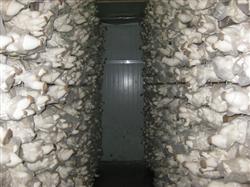
1. Mushroom house: Divided into spawn-running room, primordium-inducing room, and fruiting room. The mushroom house is 3.5M wide, 9M long, and 3.5M high. The doors of all rooms open uniformly toward the corridor (Figure 2), with a corridor width of 2M. Walls are sprayed with a polyethylene foam insulation layer. Mushroom racks are arranged in double rows, with aisles left around the perimeter and in the middle for easy operation and air circulation. The spawn-running room has 7 tiers of mushroom beds with a tier spacing of 0.35M; the primordium-inducing room and fruiting room have 5 tiers of mushroom beds with a tier spacing of 0.45M, and the bottom tier of beds is 0.25M from the ground.
2. Equipment: There are four main types of equipment: refrigeration, ventilation, misting (Figure 3), and lighting. Each room is equipped with 1 unit of 5HP refrigeration machine and 1 unit of 40M2 ceiling-mounted cooling fan; or 2 rooms are equipped with 1 unit of 8HP refrigeration unit and 2 units of 40M2 ceiling-mounted cooling fans. Two 40W fluorescent lamps are installed on the ceiling and on each of the two longitudinal walls of the primordium-inducing room and fruiting room. Each room is equipped with 1 unit of 45W axial-flow electric fan. Fresh air is pumped into the mushroom house through a buffer room, and exhaust gas is discharged from another exhaust port through the buffer room interlayer.
3. Sawdust formula (proportions per 100kg dry material): Material name Dry weight N content % N content % Remarks Hardwood sawdust 39kg 1.00 0.39kg 85% dry basis Corncob 39kg 0.48 0.19kg Same as above Wheat bran 20kg 2.20 0.44kg Same as above Calcium carbonate 2kg 0 0 Or lime Total 100kg 0 1.02kg N%=1% Sawdust is first sprayed with water and piled up, corncob is crushed into 0.3-0.5cm particles, moisture content 62%-65%. (Domestic formula: cottonseed hull 68%, bagasse 10%, wheat bran 20%, sucrose 1%, calcium carbonate 1%. Material-to-water ratio 1:1.2).
4. Bottling: Mechanical bottling, center hole punching, adding filter-air bottle caps. Use high-temperature-resistant plastic baskets (16 bottles/basket). (Bag type: polypropylene bags, width 17cm, length 36cm, thickness 0.05mm. Fill with 500 grams of dry material).
5. Sterilization: High-pressure sterilization at 121°C for 1.5 hours.
6. Inoculation: Bottle temperature below 30°C, inoculate in sterile room.
7. Incubation: Spawn-running room at constant temperature 23-25°C, dark. As the mycelium grows, the CO2 concentration in the bottle gradually rises from 0.03% in normal air to 0.22%. Higher CO2 concentration can stimulate mycelial growth, so only a small amount of air exchange is needed during incubation. After about 30-35 days of incubation, the mycelium can fill the bottle.
8. Scratching: After the mycelium fills the bottle, continue incubating for 7-10 days to reach physiological maturity. At this point, perform scratching, which means removing the 1-1.5cm thick aged mycelium
from the bottle mouth. Mechanical operation includes: opening cap → scratching → rinsing → replacing cap → scratching helps produce uniform fruiting.
9. Primordium induction: After scratching, move to the fruiting room, turn the bottle mouth downward into an empty basket to facilitate mycelial recovery and growth, air humidity 90%-95%, temperature 12-15°C, moderate ventilation. After the mycelium recovers and grows, lower the humidity to 80%-85%, creating a humidity differential; light at 500-800Lx, CO2 concentration below 0.1%, primordia form in 7-10 days. If CO2 concentration exceeds 0.1%, the fruiting bodies become deformed (Figure 4)
10. Fruiting: After primordia form, turn the baskets again so that bottle mouths face upward for fruiting, temperature 15-17°C, humidity 90%-95%. Use a misting machine to adjust humidity; do not spray water directly onto the fruiting bodies. When the primordia grow to the size of a peanut, use a small knife to thin out deformed and some overly dense primordia. The yield per bag is positively correlated with the number of mature mushrooms; the number of primordia retained per bag should be determined according to market demand. Generally, retaining 4 mature mushrooms per bag gives higher yield and quality.
11. Harvesting: Harvest when the mushroom caps have basically expanded and spores have not yet been discharged; harvest large ones and leave small ones, completing harvest in stages. When harvesting individual mushrooms, hold the base of the stipe and twist to pull out; for cluster mushrooms, use a small knife to cut. Generally, from primordium appearance to harvest takes 10-20 days. In industrial bottle cultivation, only one flush is harvested (Figure 5), with a biological efficiency of about 50%. After harvesting, mechanically empty the bottles to prepare for the next round of bottling. (Bag type: single bag with 500 grams of dry material, average yield for one flush is about 250 grams) (biological efficiency 50%); after 10 days, a second flush can grow, and the maximum yield per bag for two flushes can reach 610 grams; with casing soil, one flush can reach 154% (850/550).