Characteristics and Cultivation Key Points of the Pleurotus eryngii Xueerong 251 Strain
1. After obtaining the cultivation spawn from the research institute, attention must be paid to temperature during packaging and transport; it is best to transport in the morning or evening, and guard against high temperatures cooking the spawn. After bringing the spawn home, it should be placed in a cool, dry, well-ventilated indoor area for dark-light incubation. After the spawn has fully colonized the bag, it is best to incubate for another 7 days before starting inoculation. 2. September...
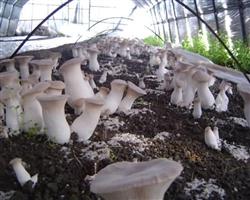 The Xueerong (Pleurotus eryngii) 251 strain, newly bred by the Fujian Academy of Agricultural Sciences' Institute of Farming and Institute of Plant Protection, belongs to the low-temperature type, with a short cycle, generally 45-60 d; the variety is excellent with high yield and a biological conversion rate of 70%-80%, and is deeply welcomed by growers in the promotion areas. Its characteristics and cultivation key points are introduced as follows.
1 Morphological Characteristics
The fruiting body of strain No. 251 has a cap 6-8 cm wide, initially arched-round with an incurved margin, later expanding, with the center gradually becoming slightly depressed, forming a funnel shape; the cap surface has silky radial dark brown fine stripes. The gills extend downward, milky white. The stipe is 8-15 cm x 2.5-3 cm, eccentric or lateral, white to pale yellow, solid, with white fibrous flesh. Spores are white.
2 Cultivation Key Points
2.1 Cultivation substrate: sawdust 38%, cottonseed hull 40%, wheat bran 15%, corn meal 5%, sugar and gypsum 1% each.
2.2 Suitable temperature range: the optimum temperature for mycelial growth is 24-26°C, and the optimum temperature for fruiting body development is 13-15°C; normal growth can occur with fluctuations of 2°C above or below this range.
2.3 Cultivation season: the local optimum fruiting temperature should be selected. In the Fuzhou area, bag preparation and inoculation in mid-September of autumn results in fruiting around early November; bag preparation and inoculation in late January of winter results in fruiting around mid-March.
2.4 Cultivation management
① After the mycelium has fully colonized the bag in about 30 d or so, primordia can be seen appearing on the substrate surface and at the bag opening; at this point they can be moved into the fruiting room (cultivation room), the cotton plug and collar removed, the bag opening straightened and opened, arranged neatly, and then covered with plastic film. Wait until the primordia differentiate into small mushroom buds, then remove the plastic film to allow the fruiting bodies to grow normally; the growth cycle is 45-50 d.
② Sprinkle water on the ground, and control the humidity in the fruiting room at 85%-95%.
③ Adjust the light in the fruiting room; the fruiting body development stage requires relatively bright scattered light, which is slightly different from other mushrooms. ④ Harvest at the proper time. The Xueerong 251 strain is mostly solitary, and also grows in clusters; the average weight of a single mushroom is about 60 g, with the heavier ones over 100 g, and the marketable rate is high. It can be harvested when the center of the cap is slightly convex.