Detailed Explanation of Key Points for High-Yield Bag Cultivation of Black Wood Ear Mushroom
In recent years, substitute material cultivation of black wood ear mushroom has become one of the paths for northern farmers to escape poverty and achieve prosperity. Farmers in Yushu County, utilizing agricultural by-product resources such as miscellaneous wood sawdust and corn cobs, cultivated 800,000 bags of black wood ear mushroom. About 60 days after inoculation, harvesting began. Each bag could yield 30-50 grams of dried wood ear mushroom. That year, 28,000 kilograms of black wood ear mushroom were harvested, with income reaching 1.2...
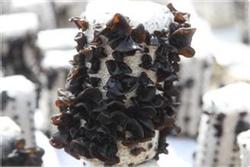
In recent years, substitute material cultivation of black wood ear mushroom has become one of the paths for northern farmers to escape poverty and achieve prosperity. Farmers in Yushu County, utilizing agricultural by-product resources such as miscellaneous wood sawdust and corn cobs, cultivated 800,000 bags of black wood ear mushroom. About 60 days after inoculation, harvesting began. Each bag could yield 30-50 grams of dried wood ear mushroom. That year, 28,000 kilograms of black wood ear mushroom were harvested, with income reaching 1.2 million yuan. One farmer cultivated 8,000 bags of black wood ear mushroom and harvested over 300 kilograms of dried wood ear mushroom that year, with a net income of 12,000 yuan. The high-yield bag cultivation (Color Figure 23) techniques are introduced as follows:
Color Figure 23 Bag-cultivated black wood ear mushroom (I) Cultivation Season Substitute material cultivation of black wood ear mushroom can produce fruiting bodies in all four seasons. Although fruiting is fast in high-temperature seasons, bags are prone to contamination by miscellaneous fungi after hanging. Therefore, the high-temperature season should be avoided for fruiting. Under normal circumstances, stock culture and cultivation spawn should be produced from late December of the previous year to early January of the following year; spawn bags should be produced from mid-February to early March. After 50 days of mycelial colonization, when outdoor nighttime temperatures reach above 10°C and daytime temperatures reach 20-25°C around May 1, the bags can be hung. May to June is the peak fruiting season, and the final flush can be harvested in September-October.
(II) Substrate Preparation The following two formulas can be used: (1) Miscellaneous wood sawdust 70%, corn cobs 10%, rice bran 10%, soybean 6%, sugar 1%, gypsum 3%. (2) Corn cobs 50%, miscellaneous wood sawdust 20%, cornmeal 10%, rice bran 10%, soybean powder 8%, sugar and gypsum 1% each. Corn cobs should be sun-dried before use, then crushed into granules the size of soybeans to improve aeration. During preparation, first mix the dry, non-moldy raw materials and cooked gypsum powder evenly, adjust pH to 4.5-5.5, and moisture content to about 60%. When squeezing a handful of substrate firmly, water should seep out between the fingers without dripping.
(III) Bagging and Sterilization Use 17×33 cm polypropylene plastic bags, filling 500 grams per bag. Fill one section and compact it before filling the next. After filling, the top should be firm and the bottom slightly loose. Pierce a vertical inoculation hole in the center of the bag substrate. Fit a neck ring with a diameter of 4 cm at the bag opening (the neck ring should be 6 cm from the substrate surface), add a cotton plug, then press the bags into an oval shape and stack them in a atmospheric pressure sterilization pot. A certain amount of space should be maintained in the pot. Use high heat to bring the water to a boil. When the temperature reaches 100°C, maintain for 10-12 hours, then remove from the pot the next morning. To prevent the pot water from boiling dry, pay attention to timely replenishment of water during sterilization.
(IV) Inoculation and Mycelial Colonization When removing bags from the pot, quickly transfer them to the inoculation room. Inoculate when the temperature drops below 28°C. Generally, each bottle of cultivation spawn can inoculate 25-30 bags. After inoculation, move the spawn bags to a dark room for mycelial colonization. For the first 10 days, control the room temperature at about 26°C, then maintain the room temperature at 20°C. Ventilate 2-3 times daily for 5-8 minutes each time. The floor of the culture room should be frequently sprinkled with water, and the indoor air humidity should be maintained above 55-65%.
(V) Building the Fruiting Shed Since indoor mycelial colonization and outdoor bag-hanging fruiting management methods are adopted, a fruiting shed should be built outdoors. The shed area depends on the number of bags to be hung. The shed height should be about 2 m. Wooden poles should be installed on the shed for threading ropes to hang bags. The fruiting shed should be close to a water source. The ground is best covered with sand and gravel to retain water and maintain moisture. The shed roof and surroundings should be covered with straw curtains. Light exposure should preferably be "three parts sun, seven parts shade." The shed should have good ventilation. The surrounding curtains should be sprayed with dichlorvos or sprinkled with lime powder for disinfection and pest control.
(VI) Hanging Bags and Making Openings After 50 days of inoculation and mycelial colonization, when the mycelium has grown to the bottom of the bag, the bags can be hung. Before hanging, it is best to soak the bags in 5% lime water for 1 minute. After drying, remove the cotton plug and neck ring, tie the bag opening with rope, and cut fruiting openings around the bag wall. Use a blade to cut 10 V-shaped or X-shaped openings on the spawn bag, each with a length of 1.5-2 cm. The cuts should not be too large, to avoid overly dense fruiting buds, slow differentiation of fruiting bodies, and uneven sizes. After cutting, tie the bags to a rope or hang them on wooden poles at the top of the fruiting shed using S-shaped wire hooks. The spacing between bags should be 10-15 cm. Tie 8-10 bags per rope and hang the entire string. The hanging density in the shed space is 80 bags per square meter. Leave a 1-meter-wide management aisle between groups of hanging bags.
(VII) Fruiting Management (1) Maintain the temperature in the shed at about 15-25°C. During the day, increase light exposure to raise the temperature and widen the day-night temperature difference to stimulate primordium formation. During high-temperature periods, lower the temperature through spatial misting, sprinkling water on the ground, and hanging wet straw curtains in the air. (2) During the early stage of hanging bags, control the relative air humidity at 60-80%. During the peak fruiting period, increase air humidity to above 90-95%. Normally, spray water into the air in the morning, noon, and evening. (3) The fruiting shed should have cross-ventilation. Ventilate at night during high temperatures and at noon during low temperatures. If ventilation is poor, carbon dioxide concentration is too high, and humidity is excessive, it will cause rotten fruiting bodies, dripping fruiting bodies, mold infection, or deformed fruiting bodies. (4) Check frequently. If contaminated spots are found on spawn bags, immediately remove them with a small knife. If the contaminated area on the spawn bag is large, immediately remove the entire bag for disposal.
(VIII) Harvesting and Processing When the fruiting bodies are fully expanded and 5-6 cm in length, they can be harvested. Handle gently during picking. Use a blade to cut them off together with the base. Harvest once every 2-3 days. After harvesting, stop or reduce water spraying, increase ventilation, and remove leftover rotten fruiting body bases. If mold contamination is found at the cut openings, use a blade to dig it out cleanly to promote re-formation of fruiting body primordia. After fruiting buds grow out, resume normal water spraying management. The final flush should be completely harvested regardless of size. Harvested fruiting bodies should be sun-dried promptly. If there is continuous rainy weather, for short-term storage, mix wet and dry fruiting bodies in a pile, then take them out to sun-dry when the weather clears, and store them in plastic bags to prevent moisture regain.
(IX) Precautions 1. Select good mother cultures and cultivate good stock cultures and cultivation spawn. Spawn used for log cultivation may not necessarily be suitable for bag cultivation. The spawn should be white, vigorous, free of large clumps, and free of miscellaneous fungi.
2. The substrate should be fresh, not moldy, and free of insects. Sterilization must be thorough. If the cotton plug gets damp when removing from the pot, it must be replaced.
3. Inoculation must be strictly aseptic. Movements should be quick to prevent contamination during the operation.
4. Strengthen fruiting management, strictly control temperature and humidity, ventilate regularly, and appropriately increase light exposure.