Detailed Explanation of High-Yield Cultivation Techniques for Black Fungus (Wood Ear Mushroom) on Logs
A sandy ground or flat grassland with a warm microclimate, small temperature difference between day and night, humid air, ample sunshine, close to a water source but not prone to waterlogging; for larger-scale cultivation sites, transportation conditions should also be considered. Low-lying plots with poor drainage are not suitable for use as mushroom yards. 1.2 Establishment of the mushroom yard: After selecting the site, it is necessary to...
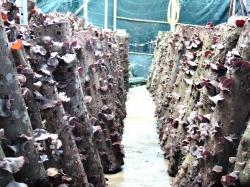
A sandy ground or flat grassland with a warm microclimate, small temperature difference between day and night, humid air, ample sunshine, close to a water source but not prone to waterlogging; for larger-scale cultivation sites, transportation conditions should also be considered. Low-lying plots with poor drainage are not suitable for use as mushroom yards.
1.2 Establishment of the mushroom yard
After selecting the site, make a plan, and according to the amount of logs, clear, level and disinfect the site. Based on our years of research, shelf-style cultivation typically requires 30-50 sq m of land per cubic meter of logs.
2 Preparation of logs
2.1 Selection of tree species and wood quality
The wood of broadleaf trees can all produce black fungus under artificial conditions, but some tree species are not suitable for promotion as production species due to their low economic value. In the eastern region of Liaoning, commonly used tree species include heartleaf hornbeam, Manchurian walnut, and oak species of the Fagaceae family. Research has proven that wood with a sapwood thickness of less than 0.8 cm is not suitable for use as logs. Wood with a diameter class of 6-12 cm grown on relatively fertile soil is ideal for logs.
2.2 Felling and processing of logs
The felling time for logs should be in winter after the ground freezes and before the sap begins to flow; logs felled at other times are prone to bark peeling, which reduces mushroom yield. After felling, branches should be trimmed and sections cut promptly. When trimming branches, the cut surface should be at a 90° angle to the radial direction of the tree, minimizing the wound surface on the log, and retaining a stub of about 0.1 cm. The length of the cut sections should be about 1.2 cm, and the cut logs should be promptly transported to the mushroom yard for drying.
3 Inoculation of logs
Inoculation of logs is an important procedure in the artificial cultivation of black fungus. A high inoculation survival rate can achieve a higher mushroom yield without any additional cost; otherwise, it leads to cultivation failure.
3.1 Before inoculation, first prepare the spawn
High-quality black fungus spawn is the primary condition for obtaining high yields of black fungus. The mycelium should be thick and dense, with strong stress resistance, uniformly white throughout, with colorless transparent water droplets adhering to the inner wall of the spawn bottle, and no shrinkage; spawn with a fresh mushroom fragrance is considered superior.
If the spawn cannot be inoculated immediately after purchase, it should be stored in a cool, clean environment free of odors. The storage temperature should be 3-5°C, and the humidity should be 65%-75%. It must not be stored together with chemical fertilizers or pesticides.
3.2 Determination of inoculation time
According to conclusions from our experiments, the optimal inoculation time is when the local natural air temperature is stable at an average of 5-8°C. Too low or too high a temperature affects the survival rate of the spawn. In eastern Liaoning, the best inoculation time is from March 15 to April 5.
3.3 Inoculation
Insert the spawn into the wood segments nearby. Our commonly used method is to first punch holes in the log, insert the spawn into the holes, and then seal the hole openings with appropriate materials.
3.4 Hole spacing
The optimal spacing is 4.2-4.7 × (7-9) cm. This depends on the wood quality of the log; harder wood can be spaced appropriately closer.
3.5 Hole depth
This depends on the hardness of the log wood; generally, a hole depth of 1.0-1.5 cm is suitable. The hole depth should not exceed the thickness of the sapwood, but should not be shallower than 1.0 cm; too shallow a depth results in less spawn being applied, affecting the survival rate.
3.6 Applying spawn and sealing holes
After punching holes, minimize contact between the wood segments and the ground to keep the holes clean; ideally, punch holes, apply spawn, and seal holes in immediate succession. When applying spawn, break the spawn into pieces and insert them into the holes, using a tool with the same diameter as the hole to push the spawn in, ensuring that the spawn makes close contact with the bottom of the hole so that the spawn can fully utilize the moisture in the log. The height of the applied spawn should be level with the xylem of the log, leaving the bark portion of the log exposed for sealing. There are many materials for sealing holes, such as wooden plugs, corn cobs, paraffin, yellow clay, etc.; regardless of the material used, it must be disinfected before use. When sealing, make sure the seal is flat and tight.
In summary, throughout the entire spawn application process, environmental hygiene must be maintained and the steps must be performed in close succession; logs punched on a given day must be fully inoculated and sealed the same day.
4 Management techniques after log inoculation
Mycelium
Throughout its entire growth and development process, it is mainly constrained by three major factors: temperature, humidity, and oxygen levels.
4.1 Temperature
The optimal temperature for the growth of black fungus mycelium is 22-32°C. Below 14°C, growth is slow; below 5°C, growth stops; and prolonged exposure above 36°C causes the mycelium to die.
4.2 Humidity
The optimal humidity for black fungus mycelium is 70%-80%. In the second week after inoculation, the water content of the spawn itself fully meets the needs of mycelium growth, so no additional watering is needed. From the third week onward, due to changes in environmental conditions such as rising temperatures and wind speed, water may evaporate; water should be replenished every 3-5 days to maintain the log moisture content above 35%, and keep the bark surface of the log free of water marks to prevent the growth of contaminating microorganisms.
4.3 Air
Black fungus is an aerobic fungus and requires a large amount of oxygen in its life activities. Ten days after inoculation, the logs should be regularly turned according to changes in environmental conditions until fruiting bodies appear on the logs. Taking stack fermentation as an example, when the surface layer temperature of the stack is 20°C, the temperature at the bottom layer of the stack is only about a few °C. However, the humidity at the bottom layer is much higher than at the surface layer, so every 7-10 days, the stack should be turned once in conjunction with watering; this ensures the oxygen needs of the logs and also regulates the temperature and humidity between logs.
5 Management during the fruiting period
When the mycelium develops to a certain extent and accumulates a large amount of nutrients in its body, it shifts from the vegetative growth stage to the reproductive growth stage. In this stage of management, temperature is no longer the main factor; humidity and oxygen are very important factors.
5.1 Early stage
When about 30% of mushroom buds appear on the log, the log should be moved to the mushroom yard. At this time, the nutrient accumulation of the mycelium in the log is not yet very sufficient, so frequent watering should be avoided to prevent excessive water content in the log and poor aeration (if this occurs, a large amount of "flowing mushrooms" will be produced). Normal management method: depending on weather conditions, water thoroughly once every 5-7 days (meaning the log fully absorbs water), gradually reducing to watering thoroughly once every 1-2 days, and finally reaching once a day. Watering should be done in the evening each day. In addition, the logs should be regularly turned end-to-end and rotated to regulate the temperature and humidity within the logs.
5.2 Middle and late stages
After each harvest of mushrooms, the mycelium is in a state of nutrient deficiency and weakness. The water content in the log is already at saturation, and the aeration of the log is very poor, so the logs should be dried in the sun promptly. The drying time can be determined by the water content of the log, generally 10-20 days. When the log moisture content drops to about 35%, the watering process of the early stage management can be resumed for the next round of mushroom production.
5.3 Harvesting of black fungus
When the edges of the fruiting bodies of black fungus show wrinkles, the mushroom stem shrinks, and a large amount of white spore powder appears on the underside of the mushroom fronds, it indicates that the fronds are mature and should be harvested promptly. Before harvesting, stop watering and sun-dry the logs, allowing the fungus to dry on the logs before harvesting (try not to harvest fresh fungus). For spring and autumn mushrooms, harvest the large ones and leave the small ones; for summer mushrooms, harvest both large and small together.