What are the common problems in the process of straw mushroom cultivation
1. Appearance of clustered mushrooms: Too large a seeding rate and uneven seeding will lead to clustered mushrooms. Therefore, the seeding rate should be controlled at 0.2-0.3 kg/sq m. The seeding method can be layer seeding, mixed seeding or broadcast seeding; it is best not to use hole seeding. 2. Aging of spawn: If aged spawn is used, although mycelial germination and colonization are normal, and the yield of the first flush is also good. But the yield of the second and third flushes is significantly reduced, and the overall yield decreases. Therefore, when purchasing spawn, you must pay attention.
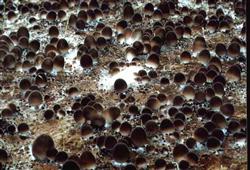 1. Appearance of clustered mushrooms: Too large a seeding rate and uneven seeding will lead to clustered mushrooms. Therefore, the seeding rate should be controlled at 0.2-0.3 kg/sq m.
The seeding method can be layer seeding, mixed seeding or broadcast seeding; it is best not to use hole seeding.
2. Aging of spawn: If aged spawn is used, although mycelial germination and colonization are normal, and the yield of the first flush is also good. But the yield of the second and third flushes is significantly reduced, and the overall yield decreases. Therefore, when purchasing spawn, you must pay attention.
3. Excessive temperature difference causing death of small mushroom buds: During the fruiting body stage of straw mushrooms, both ventilation and watering management must keep the cultivation environment as constant-temperature as possible. Ventilation can only be carried out slowly, and sudden climate changes must be closely monitored. Opening windows for ventilation is strictly prohibited on windy days. When watering, also note that the water temperature used should be consistent with the room temperature.
4. Acidification of the compost: In acidified compost, mycelial growth is sparse and weak, lacking luster, the fruiting bodies are few and small, and they easily break the veil and open the cap. At the same time, ink cap mushrooms grow in large numbers. To prevent acidification, in addition to paying attention to adjusting the pH value when preparing the compost, the water management after seeding should also be changed to spraying 0.5% lime water.
5. Compost collapse: In overly loose compost, the collapse phenomenon is severe, causing mycelial breakage, thinning of the compost, and reduced mushroom output. Therefore, after going to the bed and seeding, be sure to slightly compact the compost. If using the stack cultivation method, the stack shape should be low rather than high.
6. Pests and diseases: Using deteriorated raw materials, or incomplete pretreatment such as fermentation and disinfection of the compost, or cultivating in unsanitary places, can all lead to massive breeding of contaminating microorganisms and pests. This causes large numbers of young mushrooms on the bed surface to die, become rigid and rot, or become deformed.