Detailed Explanation of Key Points of Tremella (White Fungus) Cultivation Techniques
The raw materials for cultivating Tremella are widely available and easy to obtain, so it has great development prospects. A farming household, using just 2 rooms of 15 sq m, can cultivate 2500 bags at a time, 6 batches a year, with a net profit of over 8000 yuan. Every 100 kg of cottonseed hulls or mixed wood chips can yield 16-18 kg of dried Tremella. The main techniques are as follows:...
The raw materials for cultivating Tremella are widely available and easy to obtain, so it has great development prospects. A farming household, using just 2 rooms of 15 sq m, can cultivate 2500 bags at a time, 6 batches a year, with a net profit of over 8000 yuan. Every 100 kg of cottonseed hulls or mixed wood chips can yield 16-18 kg of dried Tremella. The main techniques are as follows:
(1) Ingredients The culture material for cultivating Tremella is made by selecting the main raw materials according to local resources and local conditions, and combining them with other auxiliary materials. Wood chips from broadleaf trees such as poplar, willow and various fruit trees can all be used. The branches of these trees can also be cut into thin slices, sun-dried, and then crushed into powdery wood chips. Cottonseed hulls are a good raw material for cultivating Tremella, and the yield per unit can be 20-30% higher than with wood chips. In addition, corn cobs, sugarcane bagasse, peanut shells, sunflower seeds, etc., after being sun-dried and crushed into fine fragments, can all be used for cultivation.
Formula 1: Wood chips 100 kg, wheat bran 25 kg, gypsum powder 4 kg, urea 0.4 kg, lime powder 0.4 kg, magnesium sulfate 0.5 kg, water 100-110 kg.
Formula 2: Cottonseed hulls 100 kg, wheat bran 25 kg, gypsum powder 4 kg, urea 0.4 kg, lime powder 0.4 kg, water 100-200 kg.
Formula 3: Sugarcane bagasse 40 kg, cottonseed hulls 20 kg, wood chips 40 kg, wheat bran 30 kg, gypsum powder 3 kg, superphosphate 2 kg, urea 0.5 kg, water 100-110 kg.
After selecting the formula, pour the main raw materials together with dry materials such as wheat bran and gypsum powder onto a cement floor, dissolve the sucrose, chemical fertilizer, magnesium sulfate, etc. in water, then pour into the dry materials, stir repeatedly three times, sift, break up clumps, and mix thoroughly, keeping the moisture content at 55-65%. Mixing the ingredients should be done on a sunny day or on a cloudy morning; it is not suitable on rainy days.
(2) Bagging The mixed culture material must be loaded into cultivation bags promptly. For Tremella cultivation bags, low-pressure high-density polyethylene tubular film should be selected, with a flat width diameter of 12 cm, film thickness of 3.5-4 silk (0.035-0.04 mm), and length of 50 cm. Every 1 kg of tubular material can be cut into 220-240 cultivation bags. Canning jars can also be used as cultivation containers. Generally, farming households use manual loading. Shake it a bit when half-loaded, compact it, then continue loading. For large-scale production, a bagging machine specially designed for edible and medicinal fungi should be used, which can fill 400 bags per hour. Bagging requires tight and solid packing, and the bag opening is tied with plastic rope. Punch 4-5 inoculation holes on the wall of the material bag, with a hole diameter of 1.2 cm and depth of 1.5 cm. Then wipe off the wood chips adhering to the bag surface, and seal the hole openings with 3.3 x 3.3 cm square paper tape, thus forming the culture medium for cultivating Tremella. From mixing the material to finishing bagging, it is best not to exceed 5 hours, to prevent the culture medium from turning sour and deteriorating.
(3) Sterilization Place a steamer on a large stove, stack the bags inside the steamer, with the tape side facing up. For large-scale production, build a special brick sterilization stove, with 1000 bags per stove being appropriate. Three key points should be noted in sterilization: First, after the bags enter the stove, there must be a fierce strong fire and leakage must be prevented, so that the temperature rises to 100°C within 4 hours; second, maintain 100°C for 14-16 hours to kill miscellaneous bacteria in the bags; third, after reaching the sterilization temperature and time, take them out while hot to prevent the tape from getting wet.
(4) Inoculation For the sterilized material bags, inoculation can only be carried out after the material temperature drops below 30°C. Before inoculation, first disinfect the inoculation room, and thinly scrape off a layer of aged mycelium from the surface of the spawn, then dig downward and stir the mycelium evenly. During inoculation, first open the tape on the bag hole opening, use an inoculator to take spawn about the size of a broad bean, quickly pass it through the alcohol lamp flame into the hole, and smoothly seal the tape again to prevent miscellaneous bacteria from invading. The spawn should be 1-2 mm lower than the tape, which is beneficial for primordium formation. Each bottle of cultivation spawn can inoculate 25-30 cultivation bags.
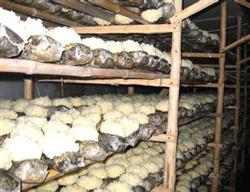
(5) Spawn running Tremella spawn running and fruiting can use the same room, and ordinary houses can be used. Professional growers with the means can build dedicated spawn-running rooms and cultivation rooms. The site should be slightly elevated, close to a water source, convenient for cleaning the site, with ventilation through doors and windows, and good light. A simple mushroom shed can also be built in the courtyard. Whether it is a dwelling or a simple mushroom shed, racks for placing cultivation bags must be set up inside. The rack layers can use bamboo and wood as the frame, with a rack height of about 2.5 m and a width generally of 50 cm. The rack is divided into 8 layers, with a layer spacing of 30 cm. Each layer of the rack is laid flat with bamboo and wood to facilitate the placement of spawn bags. The interior surroundings can be enclosed with plastic film to provide good heat and moisture retention. The cultivation room should be disinfected by spraying with Lysol and dichlorvos solution.
For the inoculated spawn bags, keep the indoor temperature at 28°C for the first 4 days, preferably not exceeding 30°C, and from day 5 onward a room temperature of 25°C is more suitable. After 5 days of cultivation, the mycelium spreads toward the hole openings. At this time, a turning and inspection should be carried out. If miscellaneous bacteria contamination is found at the inoculation holes, inject formalin to kill them. For the arrangement of the spawn bags indoors, at first stack them in piles of 4-5 bags in a # shape (crosswise) to increase bag temperature and speed up mycelial development. From day 5 onward, the bags should be placed one by one on the rack beds, laid horizontally in sequence, with a spacing of about 1 cm between bags. In winter when the temperature is insufficient, a coal fire can be used to raise the temperature, but care must be taken to remove carbon dioxide so as not to harm the Tremella mycelium.
The indoor relative air humidity should be below 70%. On the premise of maintaining room temperature, open doors and windows for ventilation 1-2 times a day for air exchange, 30 minutes each time. If the temperature has already met the above requirements, windows can be kept open for a long time to keep the air fresh.
Uncover the tape for ventilation: After about 10 days of cultivation, the mycelium in the bag has spread around the inoculation hole, forming a round shape. When the mycelium grows to a diameter of 10 cm, that is, when the mycelial circles of adjacent holes connect, lift the tape to make a round opening the size of a soybean grain, allowing oxygen to enter the material and speeding up mycelial growth and development. But before uncovering the openings, lightly spray the bag surface and the space with dichlorvos pesticide first. Twelve hours after the tape is lifted, spray with clean water, 3-4 times a day, but do not spray directly into the holes, and combine with ventilation. After 4 days, protruding white fluffy mycelial masses gradually appear in the holes, commonly known as "white fluffy masses." At this time, an indoor temperature of 20-23°C is suitable, with a relative humidity of 80-85%. As the mycelium matures physiologically, light yellow water droplets appear on the white fluffy masses (secretions from mycelial metabolism). At this time, tilt the bag toward the hole opening to let the yellow water flow out of the hole, and adjust the room temperature to 25°C to make the yellow water shrink. Generally 15-16 days after inoculation, when white broken-rice-like young fruiting bodies gradually appear in the holes, tear off all the tape, cover each spawn bag with a whole sheet of newspaper, and spray water on the paper to keep it moist.
(6) Fruiting management Tremella differentiates from the primordium into the fruiting body, generally in about 18 days. The specific methods for fruiting-stage management are:
Expand the holes to increase oxygen: Use a blade to cut away about 1 cm of film along the edge of the fruiting hole, enlarging the hole opening and increasing oxygen inside the bag.
Spray water to increase humidity: During the fruiting stage, spray water 1-2 times a day on the covering newspaper, keeping the newspaper moist as appropriate. When the fruiting body grows to 3 cm, to avoid rotten fruiting bodies, remove the covering newspaper and place it in the sun to dry for one day, then put it back into use. This should be done once every 3-5 days. Each time the newspaper is removed, it should be left off for 12 hours to let the fruiting body contact oxygen, then cover it again and continue spraying water to retain moisture. During the young fruiting body stage, spray more water; in cloudy and damp weather, spray less and ventilate more. In the middle growth stage of the fruiting body, water absorption is greater; in sunny and dry weather, spray more and ventilate less.
Pay attention to ventilation: When the Tremella fruiting body grows to 24-29 days, it is at the stage of strongest vitality, and the bag temperature is relatively high. If the room temperature exceeds 27°C, doors and windows should be opened all day for long periods of ventilation, combined with water spraying management to prevent the fruiting body flakes from drying out after ventilation.
Stop spraying and wait for harvest: At about 30 days after inoculation, the fruiting body has grown to about 12 cm, and spraying water on the newspaper should be stopped to prevent the fruiting body flakes from becoming too wet and moldy. After stopping moisture for 5-7 days, the fruiting body flakes thicken and enter the harvest period.
Harvesting and processing: For Tremella, from inoculation to harvest, the whole process generally takes 35-40 days, but if harvesting coincides with cloudy and rainy days, it can be extended by 5 days. Mature Tremella is white and crystal-clear, shaped like a peony, as large as a jade bowl, with spread fruiting body flakes and elasticity. Usually each flower reaches 15-20 cm in diameter, and the fresh weight can reach 150-200 g.