Detailed Explanation of Key Points of Mushroom Casing Soil Improvement Technology
Casing soil is an important step in the mushroom cultivation process. The properties of the casing soil material directly affect the timing of mushroom emergence and the yield. In particular, the water-holding rate and water-retention capacity of the casing soil have a relatively large impact on yield. In recent years, various regions have continuously carried out the selection and improvement of casing soil materials. From simply using vegetable field soil and river mud soil to...
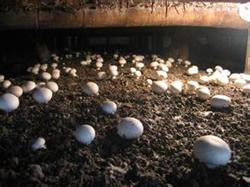
Casing soil is an important step in the mushroom cultivation process. The properties of the casing soil material directly affect the timing of mushroom emergence and the yield. In particular, the water-holding rate and water-retention capacity of the casing soil have a relatively large impact on yield. In recent years, various regions have continuously carried out the selection and improvement of casing soil materials. From simply using vegetable field soil and river mud soil to artificially prepared composite soil (such as fine mud and rice husk soil, fermented soil), and Northeast peat soil. However, in many mountainous areas of China, the soil is generally rather sandy, with poor water retention and low water-holding capacity, while clayey soil (such as vegetable field soil and river mud soil) is rarely available, greatly restricting the development of the mushroom planting industry in such areas. Practice has proved that grinding rice and wheat straw into powder and adding it in a certain proportion can greatly increase the water-holding rate of the casing soil, and the mycelium quickly and fully colonizes the soil, resulting in high yield. It can be processed using only small machinery and is worth promoting. The technology is introduced as follows:
I. Production process of straw powder
1. Cutting and crushing the straw. Select golden-colored rice straw and wheat straw free of mildew, and cut them into 2-4 cm lengths with a straw chopper or straw cutter. Use a feed grinder (with a screen aperture of 1.5 mm or 2.0 mm) to crush the cut straw segments. Generally, a 4 kW motor can crush 30 kg of straw per hour. For 111 sq m covered with about 4 cm of soil, mixing in 100 kg of dry straw powder is optimal.
2. Pre-wetting and conditioning of the straw powder. Use limewater with a pH of about 12 to pre-wet the straw powder, adding 10 kg of limewater for every 10 kg of straw powder. Note that the moisture content of the straw powder must not be too high, otherwise it will be difficult to mix the soil and straw powder evenly, forming "small straw clumps."
II. Casing soil and casing soil preparation technology
1. Proportioning and disinfection of the casing soil. One day before pre-wetting the straw powder, soak the rice husk well. Generally, soak it in limewater with a pH of 12-13 for 24 hours, then remove it, mix and stir it evenly with the already pre-wetted straw powder, and while stirring spray 1% formalin so that the moisture content of the casing soil reaches the degree where "it forms a ball when squeezed by hand and breaks apart when the hand is released." Pile it into a cone shape, cover it tightly with plastic film, and let it sit sealed for 48-72 hours.
2. Applying the soil. After sealing, remove the film, spread the soil out to let the chemical odor dissipate completely. Generally after 36 hours, spray 0.2% ju-le-he-zhi (a pesticide), so that the moisture content of the casing soil again reaches the degree where "it forms a ball when squeezed by hand and breaks apart when the hand is released," then apply the soil. Generally, for a 15-18 cm thick compost layer, apply about 4 cm of soil, with a uniform thickness.
3. Management after casing. After casing, maintain good humidity in the mushroom house, frequently spray water on the floor so that the surface is moist but without standing water, and avoid excessive water loss from the casing soil. On the 3rd day after casing, when the mycelium has just begun to colonize the soil and the soil surface is beginning to dry, spray an appropriate amount of 0.1% ke-mei-ling (a fungicide) to prevent the growth of contaminant microorganisms and to adjust the moisture content of the casing soil. In the following days, also constantly monitor the moisture content of the casing soil, because after the mycelium has colonized 1 cm of soil, water consumption is very high, so replenish water in a timely manner, keeping the moisture content of the casing soil always in the state where "it forms a ball when squeezed by hand and breaks apart when the hand is released." Generally, 7-8 days after casing, the mycelium has colonized about 4/5 of the soil layer thickness; at this point, ventilation can begin, and fruiting water can be sprayed, with management the same as conventional practice.