Detailed Explanation of a New Method for Cultivating Mushrooms Without Manure
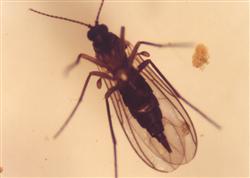
Fungus gnats, also known as "gall midges," reproduce very quickly and often carry bacteria that cause mushroom diseases; their larvae (maggots) come in white and orange varieties. Fungus gnats often lay eggs on the compost used for producing mushrooms, the eggs begin to hatch before the mycelium has fully colonized the compost, and by the time the first flush of mushrooms appears the larvae have already grown and bore into the mushroom stems and caps to cause damage. Because...
 With the spread of mushroom cultivation techniques, methods for cultivating mushrooms have also been continuously improved. Generally, poultry and livestock manure is used as the raw material for cultivating mushrooms, but the drawback is the strong odor. Below is an introduction to the new manure-free mushroom cultivation technology introduced in recent years, for reference.
I. Manure-free mushroom cultivation formula (calculated per 100 sq m)
Dry rice straw and other straw 1500 kg, urea 15 kg, ammonium bicarbonate 20 kg, lime powder 50 kg, peanut bran 75 kg or rapeseed bran 100 kg, superphosphate 50 kg, gypsum powder 50 kg. Before the compost is fermented, the suitable ratio of carbon to pure nitrogen content is between 30-31:1. After fermentation is completed, it is about 17:1. Note: slight differences occur depending on the strain type. Therefore, when preparing the compost, close attention must be paid to the ratio of carbon to pure nitrogen content. In addition, to obtain the most ideal yield, it is best to use secondary fermentation technology or thermogenic agent fermentation technology.
II. Method for stacking and fermenting the compost.
Stacking and fermentation method: A new technique in recent years is to first stack the materials in separate groups in the early stage. Straw material, nitrogen fertilizers (that is, urea and ammonium bicarbonate) and lime powder form one group, while the other materials, such as superphosphate, gypsum powder and bran cake fertilizer, form another group. When the straw material is turned for the first time, that is, after about 6 days, they are then mixed and stacked together.
Specific method: Pre-wet the straw material thoroughly 1-2 days in advance, then build the stack, following the formula by layering one layer of wet straw and one layer of lime powder, then one layer of wet straw and one layer of nitrogen fertilizer. Note: lime and chemical fertilizer must not be in the same layer. Alternate the layers in this way until the stack reaches 1.5 m high. Each layer of straw material should be 15-20 cm thick; the stack should be 2 m wide and 1.5 m high, with the length determined by the quantity. For every 100 sq m, the materials used, that is, 1500-2000 kg of straw material, make a stack 8-10 m long. The top of the stack should be shaped like a turtle shell, and the sides should be vertical and neatly form a rectangular stack. When the stack is built to a certain height, about 50 cm, an appropriate amount of water should be applied to each layer, so that on the next day there is a small amount of water flowing around the stack.
Turning: Afterward, turn the stack once every 5 days, 4 days and 3 days respectively. Generally, 3-4 turnings include mixed stacking, and the stacking and fermentation period is about 18-23 days.
Each turning should fully loosen the material and swap the positions of the upper and lower, inner and outer materials. Generally, the first two turnings use horizontal and top-stripping layered turning, while the later stage uses vertical and mixed turning. During the stacking period, if the weather is dry and the stack is relatively dry, water can be applied around the stack before turning in the early stage.
The moisture of the stack should be adjusted properly in the early stage; after the second or third turning in the middle and late stages of stacking and fermentation, nothing more can be added.
At the time of the last turning, use bricks and stones to support bamboo or wood 15-20 cm above the ground, then stack the material on top, and insert several thick moso bamboo poles or wooden sticks vertically in advance, one about every 0.8 m. After stacking is completed, pull them out the next day to form ventilation holes, which helps increase the air permeability of the stack and expel waste gas and odor, and can greatly improve the quality of the compost. Afterward, inoculation, mushroom house preparation, casing soil, and fruiting management are basically the same as conventional cultivation methods; the main points are thorough disinfection of the mushroom house and materials, as well as ventilation and air exchange, humidity control and heat preservation. Bag storage. At a temperature of 10°C-15°C, mushrooms can remain white for a long time.
III. B9 treatment: Soak mushrooms in a 10-100 ppm B9 solution for 10 minutes, remove and drain, then put them into plastic bags. At a temperature of 5°C-22°C, mushrooms can be kept fresh for a long time.