The five-character formula for water management during the fruiting period of bag-cultivated enoki mushrooms (Flammulina filiformis)
Enoki mushroom cultivation and management have high requirements, especially since fruiting body development is very sensitive to water requirements; water management during this period is the key to achieving high yield and quality. The "five-character" formula water management method is introduced here for reference. First, maintain. After the mycelium reaches the bottom of the bag, immediately open the bag and scratch the mycelium, rake away the old mycelial skin, and cover with wet newspaper or plastic film to maintain moisture and promote pinning. For those covered with newspaper, spray water in small amounts and frequently (3-4 times per day) to keep the newspaper moist; for those covered with plastic film, spray water onto the floor and into the air to maintain air humidity at around 90%. During this period, open windows for ventilation once a day, keep the room temperature at 10-14°C, and after 5-7 days mushroom pins will emerge in large numbers.
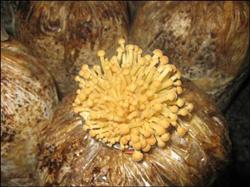
Enoki mushroom cultivation and management have high requirements, especially since fruiting body development is very sensitive to water requirements; water management during this period is the key to achieving high yield and quality. The "five-character" formula water management method is introduced here for reference.
First, maintain. After the mycelium reaches the bottom of the bag, immediately open the bag and scratch the mycelium, rake away the old mycelial skin, and cover with wet newspaper or plastic film to maintain moisture and promote pinning. For those covered with newspaper, spray water in small amounts and frequently (3-4 times per day) to keep the newspaper moist; for those covered with plastic film, spray water onto the floor and into the air to maintain air humidity at around 90%. During this period, open windows for ventilation once a day, keep the room temperature at 10-14°C, and after 5-7 days mushroom pins will emerge in large numbers.
Second, lower. When the pins grow to 1-2 cm, they enter the growth inhibition stage. At this time, reduce or stop spraying water and lower the humidity. For 3-5 consecutive days, open doors and windows at night to let cold air in to cool down and dissipate moisture, lowering the room temperature to below 8°C (4-5°C is best) and the humidity to around 75%, so that the fruiting bodies are inhibited and grow uniformly and robustly.
Third, promote. When the fruiting bodies grow to 3-4 cm and enter the elongation stage, spray water 4-5 times per day. The amount of water sprayed increases as the mushrooms grow, keeping the air humidity at around 90% (that is, fine water droplets adhering to the bag wall at the base of the fruiting bodies is ideal), to promote rapid growth of the fruiting bodies. At the same time, ventilate appropriately, alternating wet and dry conditions to inhibit cap enlargement and promote stipe elongation. At this stage, the amount of water sprayed should be based on weather conditions: spray appropriately more on sunny days and less on rainy days, to prevent root rot, brown spot disease, and excessive water content in the mushrooms turning them into waterlogged mushrooms and reducing quality due to excessive water use. Never spray water onto the caps; if the newspaper is found to be damaged, replace it promptly, and if there is standing water on the newspaper, pour it off immediately, to prevent the fruiting bodies from contacting water droplets and developing black spots that affect the commercial appearance.
Fourth, supplement. After the first flush of mushrooms is harvested from the bags, the water content decreases by 20%-30%, and after the second flush is harvested it decreases by 30%-50%. Therefore, after the first and second flushes are harvested, immediately spray water into the scratched bags to supplement moisture. The method is: for 2-3 consecutive days, spray water directly into the bags 2-3 times per day, each time just enough to moisten the surface of the mycelial column, without allowing water to accumulate in the bag. To increase yield, a small amount of urea, white sugar, potassium dihydrogen phosphate, etc. can be added to the water to supplement nutrients.
Fifth, soak. After harvesting the third flush, the water content of the mycelial column has dropped below 50%. At this point, remove the plastic bag and soak the mycelial column in a pool of water (with a heavy object placed on top). When the mycelial column has absorbed water and returned to its original weight when the bag was first opened, take it out, let it dry slightly, and put it back into the bag. Alternatively, water can be injected directly into the bag for soaking, and after the mycelial column has absorbed enough water, pour off the excess water in the bag. After replenishing water, rearrange the bags on the bed frames, cover with wet newspaper, and manage as usual; in this way, two more flushes can be harvested.