How to manage the fruiting period of king oyster mushrooms? These key points you need to master
Control the environment and try to keep the ambient temperature within the growth range. The growth temperature of king oyster mushrooms is 6°C to 25°C. At 6°C to 15°C, the fruiting body grows slowly, but the fruiting body tissue is dense and the color is attractive, so high-quality mushrooms can be cultivated. Management during the bud stage 1. Increase ventilation. Only by increasing ventilation can the growth of the cap be promoted and the stipe be inhibited...
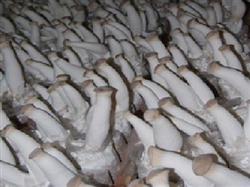 The fruiting temperature of king oyster mushrooms varies with the characteristics of the strain. Generally, fruiting is arranged when the indoor temperature is stable at about 10°C and the optimal temperature is 7°C to 15°C.
1. Promoting buds. After completing the post-ripening treatment, adopt temperature difference stimulation. Especially when fruiting in early winter, subjecting the bags to low-temperature stimulation is a very necessary step; otherwise, it will lead to difficulty in bud formation. If the stimulation is appropriate, after about 10 days, white dot-like primordia will form on the surface of the substrate at the bag opening. When cultivating in autumn, take measures to appropriately lower the shed temperature; when cultivating in spring, try to raise it, and slightly increase the ventilation volume while maintaining the original shed humidity. After the primordia appear, adjust the shed humidity to about 95%, widen the temperature difference as much as possible, keep the light intensity at 1000 lux, and provide a small amount of ventilation. Cut off the tied opening or fold the bag opening downward to expose the substrate surface. The number of primordia will continue to increase and then differentiate, and young buds will appear. At this stage, the shed temperature should be strictly controlled below 20°C.
2. Young bud stage. Young buds are tiny and weak, and require relatively strict and stable environmental conditions. At this stage, the shed temperature can be stabilized at about 15°C, the shed humidity at 90% to 95%, the light intensity at 500 to 700 lux, and a small amount of ventilation can be provided, keeping the shed relatively cool, highly humid, weakly lit, and with fresh air. After about 3 to 5 days, the young buds differentiate into young mushrooms, and the basic shape of the fruiting body can then be seen.
3. Young mushroom stage. Young mushrooms still have a weak ability to resist adverse external factors. At this stage, relatively stable conditions such as temperature, water, and air still need to be maintained. To promote faster growth and greater sturdiness, the light intensity can be appropriately increased to 800 lux, but as light increases, the color of the fruiting body will become darker, so moderation is needed. At about 13°C, after about 7 days, they can enter the mature mushroom stage. The young bud and young mushroom stages are the main stages in which shrinkage and death occur. The main causes are excessively high or low temperature, especially the first flush in autumn cultivation and the second flush in spring cultivation, which are in an environment with large temperature differences. A slight negligence in management, improper measures, or delayed management will cause the shed temperature to rise or fall sharply. Once it is below 8°C or above 22°C, young buds can yellow in large numbers, shrink, and then die. Therefore, according to the biological characteristics of each strain, strictly and effectively regulating all conditions and correctly handling the contradictions among temperature, air, water, and light so that the fruiting body is in a relatively suitable environment at each stage and the mortality rate is reduced to the maximum extent have become the criteria for judging the quality of fruiting period management.
4. Mature mushroom stage. To obtain high-quality fruiting bodies, conditions should be created to lower the shed temperature to about 15°C, control the shed humidity at about 90%, reduce the light intensity to 500 lux, and increase ventilation as much as possible, but do not let strong wind, especially airflow with a large temperature difference, blow on the fruiting bodies. When the wind is strong, cotton gauze can be hung at doors, windows, and ventilation holes and sprayed wet, or the air inlet can be reduced, so as to ensure fresh air in the shed and coordinate the balance among air, temperature, and water, which will place the fruiting bodies under relatively suitable conditions and allow them to grow healthily and normally.
5. Harvesting. When the fruiting body has basically grown up, the base is raised but not soft, the cap is basically flat and concave in the center, and the edge is basically flat but spores have not yet been discharged, it can be harvested in time; at this time it is about 80% mature. If production is on a relatively large scale, it can be harvested at 70% maturity.
6. Post-harvest management. Clean the fruiting surface and clean the mushroom shed. When fruiting in spring, spray once with pyrethroid insecticides, then seal and shade it so the bags can rest and recover. When fruiting in early winter, just spray once with fungicides such as Saibai 09. After primordia appear again on the substrate surface, fruiting management can be repeated. Generally, 1 to 3 flushes can be harvested. The biological efficiency of columnar mushrooms is 80% to 120%, and the biological efficiency of bowling-ball-shaped strains is about 80%, with a commercial rate of 80% to 90%. If mycelial post-ripening management is relatively well done, only one flush, or at most two flushes, can reach a relatively ideal yield level.