Key technical points for getting more mushrooms from king oyster mushrooms in spring
1. Grasping the best fruiting period for king oyster mushrooms. King oyster mushrooms have been cultivated in Panjin, Liaoning, for several years now, and the experience gained is that the most suitable fruiting period for producing king oyster mushrooms in local mushroom sheds is from early March to the end of April in spring, and from late September to early November in autumn. Without heating facilities, during this period...
 Control the ambient temperature and try to keep the ambient temperature within the growth range. The growth temperature of king oyster mushrooms is 6°C-25°C. At 6°C-15°C, the mushroom bodies grow slowly, but the mushroom tissue is dense and the color is attractive, so high-quality mushrooms can be cultivated.
Control ambient humidity. Ambient humidity should not be too high. At a temperature of 6°C-15°C, spraying water once or twice a day in the mushroom shed is enough. For cultivation using the soil-covering method, there is no need to spray water every day; this can be flexibly adjusted according to changes in outside temperature. Maintaining relative air humidity at around 80% is sufficient.
Pay attention to strengthening ventilation. In an environment of 6°C-15°C, generally ventilating for 1-3 hours a day is enough, and ventilation can be done at noon or in the afternoon. Especially in cold winter, prevent nighttime ventilation from making the mushroom site too cold and causing freezing damage.
Control fruiting light. When the temperature is below 15°C, direct sunlight does not affect the growth of the mushroom bodies, and their color does not change, but when the temperature is relatively high, strong direct light will cause the mushroom bodies to turn yellow and deteriorate.
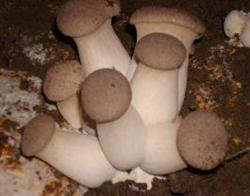
Standards for high-quality mushrooms: the mushroom body is smooth and free of off-colors, shaped like a club or a bowling pin, weighing more than 50 grams and less than 200 grams, with a cap diameter of 2-6 cm, a cap thickness of 1-4 cm, and a stipe of more than 5 cm.
To cultivate king oyster mushrooms according to these standards, the following work is needed: 1. Thin the mushrooms at the mushroom bud stage. Manage according to high-quality standards, and it is best to keep only 1-2 mushroom buds at the fruiting end of each fungus bag. 2. Strengthen ventilation. Only by strengthening ventilation can the growth and development of the cap be promoted and the growth of the stipe be inhibited. 3. Reduce water use during the fruiting period. Too much water during the fruiting period will lead to excessively high water content in the mushrooms, causing darker stripes or cracks on the surface of the mushroom bodies, thereby affecting mushroom quality. 4. Harvest appropriately early. Harvesting 3-5 days early can maintain the whiteness of the mushroom bodies and prevent them from turning yellow during storage and transportation after harvest, which would affect quality. 6. Harvest standard for king oyster mushrooms: the fruiting bodies of king oyster mushrooms are more suitable for harvest when they are 70% mature. At this time, the appearance of the mushroom bodies is dense and elastic, the edge of the cap is incurved and hemispherical, and the gills have not yet formed. Harvesting when the cap is flat, the gills have formed, and the mushrooms are close to maturity will reduce quality and shorten the storage period.