What are the key technical points for managing Agaricus bisporus during the fruiting period?
I. Watering to press down the mycelium should be done at the right time. When mycelium emerges on the bed surface, it indicates that the mycelium has grown to the bottom of the compost and has fully developed within the casing layer, and has already gained the ability to form mushrooms. At this point, water should be sprayed at the right time to press down the mycelium. Method: increase ventilation so that strong wind blows into the mushroom shed and causes the mycelium on the soil surface to lie flat; determine the amount of water sprayed according to the mycelial growth in the casing layer, generally every...
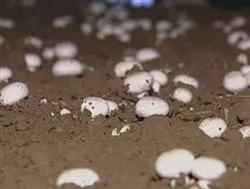 Currently, Agaricus bisporus is at the fruiting stage, and growers should manage this period well to achieve higher yields.
I. Water management
Water management is very important in edible mushroom production, and regulating water in the casing layer is a crucial technical step in water management. There are two methods to choose from: first, adopt the spraying method, with fine mist, so that the casing layer is not soaked through but moistened through, using 1-2 days to bring the casing layer to its maximum water-holding capacity. This method has less impact on the mycelium in the casing layer and is suitable for relatively clayey soil; second, apply a heavy mushroom-forming water, by the method of pouring, using sufficient water in one go. The greatest advantage of this method lies in the use of heavy water, which can effectively stimulate the rapid transformation of mycelium from vegetative growth to reproductive growth, and is suitable for casing materials with good physical and chemical properties. Afterward, methods such as misting the air space should be adopted to keep the air humidity inside the shed at 85%-95%.
II. Temperature management
At this stage, the temperature in the mushroom shed is generally 11°C-20°C, within the suitable range for the growth of Agaricus bisporus fruiting bodies, and almost no regulation is needed for normal growth. However, as the temperature drops, insulation measures should be strengthened, mainly by adding a layer of plastic film over the straw matting and ventilating at noon. In this regard, management of winter-warm greenhouses is relatively simpler, while for ordinary sloped greenhouses, after late November or December, it is very difficult to maintain the required temperature. In recent years, some producers have achieved good results by heating fire walls, using small coal stoves, and similar methods. In low-temperature seasons, as long as the temperature is kept above 8°C, the requirements for fruiting body growth can be met. If conditions permit, installing water-temperature air conditioning in the greenhouse can achieve temperature regulation within a certain range.
III. Ventilation management
The effectiveness of ventilation in the mushroom shed is directly related to the level of yield and the quality, but most mushroom growers tend to focus on temperature and water management while neglecting ventilation management, which is a major factor. Ventilation in the mushroom shed, in addition to being needed for the growth of mycelium and fruiting bodies, plays a very important role in removing or diluting carbon dioxide while also carrying excess moisture out of the shed, and this is especially important when humidity inside the shed is too high and fog is too heavy. In addition, good ventilation can reduce the occurrence of certain diseases in the shed. In production, the carbon dioxide concentration in the shed is generally required to be around 0.05%, and not to exceed 0.1%. The intuitive feeling is that there is very little off-odor in the shed, with no obvious heavy smell of fermented manure and straw compost. However, there should not be an overly strong airflow blowing directly across the bed surface, otherwise it easily causes water loss from the casing soil or the substrate.
IV. Light management
The greatest characteristic of Agaricus bisporus is that during the fruiting body stage it can grow normally with almost no light, but under weak scattered light conditions, it is also not harmed in its growth and development. Therefore, in production, the mushroom shed can be tightly covered, and only when entering to work should the corners or ventilation holes be opened. If conditions permit, lights can be turned on for illumination, and turned off when people leave.
V. Timely harvesting
When the fruiting bodies grow to more than 4 cm in diameter, still in a tightly wrapped state with the membrane intact, but with growth rate clearly slowing down, they can be harvested in time. Preparations for harvesting should be made in advance. For example, latex gloves should be worn during harvesting to prevent finger marks from being left on the mushroom caps, which can cause browning at those spots and affect mushroom quality; also, tools such as basins and baskets used for holding mushrooms should be disinfected in advance to avoid contaminating the mushrooms.
VI. Post-harvest management
After the first flush of mushrooms is harvested, the compost bed should be cleaned up in time, removing mushroom stumps, dead mushrooms, rhizomorphs, and so on, filling in depressions. If conditions permit, a Sanwei Jingsu solution can be applied, with 120 grams diluted in 60 kg of water, applied to 60 sq m of bed surface, followed by watering with clear water to firm it down, allowing the mycelium to rest and recuperate, so as to favor the occurrence of the next flush and high yield.