Three key techniques to master in the mushrooming management of the white king oyster mushroom
As a premium and rare edible mushroom, the white king oyster mushroom has developed rapidly in China, but many cultivation attempts end in failure. I would now like to share some of my experience in cultivating the white king oyster mushroom with everyone. 1. Post-ripening cultivation: after the mycelium of the white king oyster mushroom has fully colonized the bag, it cannot be induced to fruit immediately; it needs 50-60 days of physiological maturation before it can fruit. At this stage...
 I. Master the "opening" step
During the mycelial growth phase of the white king oyster mushroom, the key technique of "opening" must be firmly grasped. The specific method is: after the fungus bags have been cultured in the mycelial growth room for 40-50 days and the mycelium has reached the bottom of the bag, they can be moved into the fruiting house or shed, placed on shelves and spaced out. After 1-2 days, carry out opening cultivation. Method of operation: for short-bag cultivation, untie the bag mouth and loosen the bag film; for long-bag cultivation, tear off the adhesive tape over the inoculation holes so that the mycelium inside the bag can better contact the air. This procedure is referred to as "opening."
After opening, continue cultivation for 10-20 days. For short bags, use a small rake inserted into the bag to scrape away the original spawn block and the mycelial skin within a 3.5 cm radius around it; some production areas call this procedure "scratching." However, note that other areas must not be scratched. Then cover the top of the bag mouth with old newspaper and spray water on the paper surface to retain moisture. For long bags, the original spawn block at the inoculation hole can be dug out, which not only increases mycelial aeration but also serves as a measure to position fruiting. Likewise, cover the bag surface with newspaper and spray water on the paper surface to retain moisture. This practice is called "training the mycelium" by mushroom farmers. At this stage, an indoor temperature of 15-20°C is suitable, with constant-temperature cultivation; the spatial relative humidity should be 75%-80%, and the duration should be 5-7 days, allowing the mycelium to continue to "conserve its strength" in a suitable-temperature environment so as to build up a strong maternal body for fruiting.
II. Master the step of "low-temperature squatting of the mycelium and variable-temperature forcing of primordia"
After the white king oyster mushroom bags have undergone opening and oxygen-enrichment cultivation, the key technique of "low-temperature squatting of the mycelium and variable-temperature forcing of primordia" must be firmly grasped. At this stage, low-temperature squatting at 0-13°C, a day-night temperature difference of more than 10°C, and stimulation by 300-800 lux of scattered light are needed to force the mycelium to shift from vegetative growth to reproductive growth. This is the distinctive characteristic that sets the white king oyster mushroom apart from other mushrooms in inducing primordia and forcing primordia. At this time, the most ideal temperature in the mushroom house is between 0-13°C. The air relative humidity should be kept below 80%. Low-temperature squatting lasts 8-12 days. Then it shifts to variable-temperature forcing of primordia. Specific method: for house cultivation, close doors and windows; for shed cultivation, tightly cover the bed film, so that the house or shed temperature reaches above 18°C. At night, open the doors or uncover the film to let cold air strike inside the house or shed, thus creating a day-night temperature difference of more than 10°C. Carry out this temperature-difference stimulation continuously for 10-15 days. Also increase ventilation and lower the spatial relative humidity to force the mycelium to lie down, and then primordia will appear. When the above environmental conditions can be met during the primordium induction and forcing stage, generally within 10-15 days, primordia the size of rice grains will appear and gradually develop, expand and differentiate into mushroom buds.
III. Master the step of "scientific management"
From the appearance of primordia to the maturation of the fruiting body, the white king oyster mushroom requires 12-15 days under suitable-temperature environmental conditions. This stage is called the fruiting body growth period. In terms of management, the following must be done:
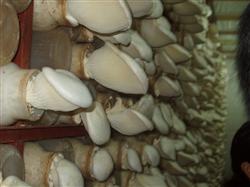
1. Fruiting body development stage. In order to ensure that nutrients are concentrated to grow high-quality mushrooms, bud thinning and plant control must be carried out. For clustered growth, select the superior and remove the inferior; for short-bag cultivation, keep one mushroom per bag. While selecting buds and controlling plants, cut off the bag mouth film so that the mushroom body can better contact the space. For long-bag cultivation, position according to the original inoculation hole, keep one at each position, and harvest the excess. After bud thinning, enter fruiting management. At this time, do not cover with newspaper. Keep the mushroom shed at 13-18°C, which is most ideal. Keep the air relative humidity between 80%-90%. Generally, do not spray water directly on the mushroom bodies. When the climate is dry, spray the space or splash water on the ground to increase humidity.
Keep the air in the house or shed fresh; a light intensity of 500 lux is acceptable, and 800 lux is more ideal. If the above requirements are met, thick and high-quality mushroom bodies with short stipes can be obtained.
2. Fruiting body maturation stage. From inoculation to harvest generally requires 90-120 days. For short-age cultivation, 60-70 days. During the maturation stage, the mushroom house temperature should be controlled above 10°C and below 20°C for the best quality. During the fruiting body maturation stage, the spatial relative humidity should be kept at about 85%, and it should not be too wet. At the same time, strengthen ventilation and air exchange, maintain scattered light, and promote thick mushroom bodies with a pure white color.
3. Fruiting body harvest stage. When the white king oyster mushroom matures, the cap flattens and spreads, with the center either flat-swollen or sunken to varying degrees. When the cap margin curls outward, the cap margin is glossy, and the gills are clear and spread out, it can be harvested. The white king oyster mushroom generally fruits once per inoculation, with a biological conversion rate of 80%-120%, and a production cycle of 100-135 days. It is also possible to turn over one end of the short bag after harvest, remove the film, scratch the mycelium, and inject water; for long bags, remove the bag, bury the cylinder, and cover with soil. With proper management, it can also fruit one more time.