In the process of oyster mushroom cultivation, the seed production stage must be strictly controlled.
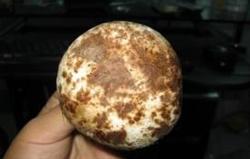
Rust-colored or dark brown spots appearing on the caps and stipes of oyster mushrooms are called oyster mushroom rust spot disease. This disease is a bacterial disease that readily occurs during the fruiting body growth stage of oyster mushrooms. The pathogen causing this disease is a species of Pseudomonas bacterium that is extremely widely distributed in nature. In the early stage of the disease, the spots are only the size of a needle tip, and the color...
 Mother culture → stock culture
When purchasing test-tube mother cultures, pay attention to identifying the quality of the mother culture and carefully examine the mycelial growth in the test tube, so as to avoid buying aged mother cultures. Generally speaking, a healthy mother culture shows white, thick mycelium with neat tips. If the mycelium is dry and scattered or the culture medium has shrunk, and there is yellow liquid accumulated at the bottom of the bottle, it indicates that the mycelium has aged; do not purchase it.
Going from mother culture to stock culture is the first expansion culture process of the mushroom seed. The specific method:
Material preparation: test-tube mother culture, beer bottles (prepare according to the amount of 1 test-tube mother culture inoculating 12 beer bottles); corn kernels or wheat grains (prepare according to the amount of 250-300 grams of corn kernels or wheat grains per beer bottle), etc.
Operation process: first treat the culture material. If wheat grains are selected, soak them in water for 24 hours (change the water 3 times during this period to prevent acidification); if corn kernels are selected, because their seed coat is thicker and not easy to soak through, they need to be cooked before use. Note that when cooking corn kernels, the heat must be controlled properly: the corn kernels must neither "split open" nor be cooked on the outside while still raw inside.
When the amount of culture material loaded into the beer bottle reaches 4/5 of the bottle, seal the opening with a cotton plug and wrap the outside with kraft paper to prevent steam from wetting the cotton plug during high-temperature sterilization. Then place the bottles on a steamer for high-temperature sterilization for about 12 hours.
After sterilization is completed, wait until the bottle temperature drops to 30°C, then transfer them to a sterile inoculation box for inoculation, that is, use an inoculation needle to lift a small amount of mycelium from the mother culture test tube and quickly place it into the beer bottle, seal the opening with a cotton plug, and wrap the outside with kraft paper. Then, place the inoculated beer bottles indoors at about 25°C for storage to promote mycelial growth. Generally, after 20-25 days, the stock culture can be obtained.
Reminder: Good stock culture mycelium is dense, white, uniform in growth, thick, cottony, and shows wall-climbing phenomenon. After the stock culture fully covers the bottle, it must immediately be expanded and propagated into cultivation spawn; otherwise, once the nutrients are exhausted, the mycelium will age and may even die.
Stock culture → first-level cultivation spawn
When stock culture is expanded and propagated, it becomes cultivation spawn. However, because the amount of stock culture is relatively small, if it is directly transferred into mushroom bags for fruiting production, not only will the spawn-running period be prolonged due to the small amount of spawn and weak spawn vigor, but fruiting will also be uneven because the growth speeds at the two ends of the mushroom bag are inconsistent. Therefore, it is recommended that mushroom growers adopt a seed production model of small bags first and then large bags, that is, first inoculate the stock culture into small mushroom bags for small-bag seed production, and then transfer it into large mushroom bags for formal cultivation. In this way, sufficient spawn-running speed and uniformity can be ensured, the spawn vigor is strong, and the probability of contamination by competing microorganisms is small.
Material preparation: first-grade cottonseed hulls (add water to moisten until, when squeezed in the hand, water appears between the fingers but does not drip; add an appropriate amount of lime to adjust the pH, and stir evenly); small mushroom bags (polyethylene plastic bags with specifications of 18 cm x 40 cm x 0.03 cm or 22 cm x 45 cm x 0.04 cm; prepare according to the amount of 1 beer bottle divided into 10 small mushroom bags), etc.
Operation process: first put the previously prepared culture material, cottonseed hulls, into small mushroom bags, tie both ends tightly, then place them on a steamer for high-temperature sterilization, maintaining 100°C for 20 hours. After sterilization is completed, place them in a ventilated and cool place to cool; inoculation can be carried out when the temperature is below 30°C. To facilitate inoculation, use an inoculation spoon to pour all the stock culture in the beer bottle into a small basin, or first wrap the beer bottle with tape several times, then break the bottle, remove the broken glass, and put the stock culture into a small basin for later use. When inoculating, use an inoculation spoon to put the stock culture into both ends of the small mushroom bag. Finally, place the inoculated small mushroom bags in a place with relatively constant temperature for cultivation; generally, the mycelium can fully cover the entire bag in about 20 days.
Reminder: When placing the inoculated small mushroom bags, note that because residual heat remains in the mushroom bags and the mycelium also generates a large amount of heat during growth, they should not be stacked too high. Generally, stacking 3-4 layers in a "#" shape is sufficient to facilitate ventilation and heat dissipation and avoid "spawn burning." In addition, during the cultivation process of first-level cultivation spawn, the bags should be turned frequently to prevent heat accumulation, and at the same time check the mycelial growth and whether there is contamination, etc. Generally, turning the bags 3 times during the entire cultivation process is sufficient. After the mycelium fully covers the bags, it must immediately be transferred to large mushroom bags; otherwise, it is easy to cause mycelial aging and reduce its production efficiency.
First-level cultivation spawn → second-level cultivation spawn
At present, oyster mushroom cultivation is mostly based on raw material cultivation, and the culture material is mainly cottonseed hulls, with appropriate amounts of corncobs, bran, lime or gypsum, sugar or cornmeal, trace elements, inorganic salts, etc. added to make the nutrition comprehensive and balanced. Because it is raw material cultivation, the culture material must be treated with a chemical fungicide before use. Method: when adding water and mixing the culture material, mix in kemeling (sodium dichloroisocyanurate), with 0.5 kg of kemeling mixed into 500 kg of culture material, then cover it with plastic film and let it sit for about 12 hours. Finally, divide the culture material into large mushroom bags. Note that in this step, it is advisable to use the method of "four layers of spawn and three layers of material" for bagging and sowing to accelerate spawn running and improve fruiting results. According to this method, one small bag of cultivation spawn can be divided into 2-3 large mushroom bags.