Wavy cultivation of shaggy ink cap mushrooms yields higher production
Choosing the spawn must be "accurate." Feeding and sowing in August to September, when natural temperatures are high, means that during the fruiting period temperatures above 30°C may sometimes occur; after entering October, temperatures will gradually decrease. To ensure normal fruiting during both high and low temperature periods, the spawn selected must certainly be an excellent strain that is both tolerant of high temperatures and also capable of fruiting at lower temperatures...
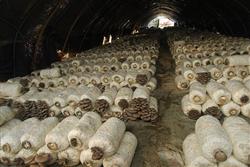 The shaggy ink cap mushroom (Coprinus comatus), with its characteristics of rich nutrition, delicious taste, high dietary therapy value, and good economic returns, has achieved rapid development in the past two years. In order to explore the best cultivation model for shaggy ink cap mushrooms and enable them to produce higher economic benefits under the same production conditions, scientific and technical personnel from the Zhijiang City Edible Fungi Association in Hubei Province made some useful attempts. Experiments proved that wavy cultivation of shaggy ink cap mushrooms gives high yields and higher benefits. The technical method is briefly introduced as follows.
The so-called wavy cultivation model means that when spreading material and sowing, the culture material on the bed surface is designed into an uneven series of wave crests and wave troughs, shaped like waves on the water surface. The greatest advantages of this cultivation model are: first, it increases the surface area of the bed surface for fruiting; compared with a flat cultivation bed surface, the fruiting area increases by more than 50%. Second, it can effectively regulate the microclimate environment on the bed surface and within the material. In terms of ventilation and oxygen supply, expelling harmful gases from the material, and regulating material temperature, it is superior to the flat cultivation method. Third, without increasing any investment, the yield per unit area of cultivation can be increased by 30%-40%, the biological conversion rate of raw materials is significantly improved, and economic benefits increase markedly.
Operation and implementation method: the production procedures in the early stage, including ingredient mixing, fermentation, arrangement and disinfection of the cultivation site, and the various management tasks in the later cultivation stage, are the same as those of conventional cultivation methods. The differences are: first, the width of the bed surface is designed as 120 cm, which helps improve the utilization rate of ordinary agricultural film. Second, layered sowing is adopted, that is, 2 layers of material and 2 layers of spawn, to speed up spawn running. Third, when spreading material and sowing, lengthwise on the bed surface, first spread three strips of material at equal distances, each 30 cm wide and 10 cm thick, leaving two gaps each 15 cm wide in between temporarily without material. After the material surface is slightly leveled, sow 1/3 of the total spawn amount, then spread another layer of material 15 cm thick on the material surface, and at the same time spread material 3 cm thick in the reserved gaps, then immediately arrange the material surface into a semicircular shape (turtle-back shape), so that wave crests and wave troughs are formed, with the wave crests 22 cm high and the wave trough bottoms 15 cm wide. Finally, evenly sow the remaining 2/3 of the spawn over the entire material surface, pat gently flat with a wooden board, cover with film and straw curtains, keep warm and moist, and manage spawn running. After about 15--20 days, when the hyphae in the material have grown into half or 2/3 of the material, promptly cover with artificially improved casing soil. When casing, the casing soil thickness at both wave crests and wave troughs should reach 5 cm. After casing, in 15-18 days, abundant fruiting can occur at both the wave crests and wave troughs. Experiments proved that when the casing soil thickness for shaggy ink cap mushrooms is about 5 cm, the mushrooms grown are plump, with thick and short stems, delayed cap opening, high yield, good quality, and high price with good sales.