Methods and Technical Key Points for Improving the Efficiency of Shiitake Mushroom Cultivation
At this stage, due to the massive proliferation of mycelium, not only is the mycelial mass large, but rich nutrients have also been stored. At this point the mycelium has entered the physiological maturation period. If a constant temperature, sufficient moisture and fresh air continue to be provided, the mycelium will remain in an active growth state and will find it difficult to enter the fruiting body stage. Therefore, in the mushroom...
 In recent years, the prices of raw and auxiliary materials for shiitake mushroom production have risen, while the prices of shiitake mushroom products have declined year by year, resulting in poor returns for farmers growing mushrooms. According to investigation and analysis, the current yield of 700-800 grams per bag has already reached a high-yield level. Because the production season is overly concentrated, the market fluctuates greatly. At low prices, each kilogram sells for less than 2 yuan. After deducting the cost of 1.5 yuan per bag, only 0.5 yuan remains, and this includes the value of labor, so the actual profit is very little. The purpose of farmers growing mushrooms is to obtain the benefits they deserve, and being unprofitable will inevitably dampen their enthusiasm for production. In today's deepening development of the market economy, to improve the efficiency of mushroom growing, it is necessary to conform to the market, use ingenious means, and adopt scientific measures in order to avoid risks and achieve the goal of high yield and high efficiency. Below are feasible paths for reference in production:
Enter the market in reverse, cleverly capturing the benefits of seasonal price differences〉
Conventional shiitake mushroom production is mostly autumn cultivation, with mushrooms produced in autumn, winter and spring. At this time it overlaps with the mushroom production periods of Japan and South Korea, and a large number of mushroom products enter the international market, temporarily putting products in a saturated state and causing prices to fall. But in summer, when temperatures are high, shiitake mushroom supply is scarce, and general prices rise by 10-20 percent. In particular, the purchase price of fresh-keeping mushrooms for export is 6-8 yuan per kilogram, and when high it exceeds 10 yuan, increasing value by 1-2 times compared with conventional production. Therefore, 20 percent of total production can be arranged for off-season cultivation, with products entering the market in reverse. In mountainous areas with natural temperatures suitable for off-season cultivation, production bases can be established, and programmable micro-sprinkler equipment can be used to improve the temperature and humidity of the mushroom shed environment, increase yield, and obtain better benefits.
Intensive cultivation of flower shiitake mushrooms, skillfully obtaining quality-grade benefits〉
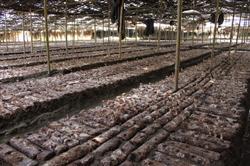
Change the conventional cultivation method of placing bags in the open field to cultivate ordinary commercial mushrooms, and adopt tall sheds with multiple racks for intensive three-dimensional cultivation of flower shiitake mushrooms. In a normal year, the price of dried flower shiitake mushrooms is 45-60 yuan per kilogram, which is 68-95 percent higher than the value of dried ordinary commercial mushrooms, and the value of high-quality Tianma flower shiitake mushrooms is 1-2 times higher than ordinary mushrooms. With the same raw materials and the same site, only the cultivation and management methods differ, yet the product price difference is several times greater, and 60 percent of land is saved. This is a means of improving quality-grade value benefits. For flower shiitake cultivation, the new double-bagging technique should be promoted, with a specially made thin plastic bag as the inner lining, so that the mushroom buds break through the film themselves, eliminating the film-cutting procedure, keeping products hygienic and avoiding damage. This is a reform, a new technique that helps save labor and improve the quality of flower shiitake mushrooms.
Combined cultivation, striving for comprehensive benefits〉
Promote mushroom-grain intercropping, such as growing shiitake mushrooms in corn fields in Northeast China, achieving a double harvest of grain and mushrooms; interplanting in forest and orchard land, cultivation under grape trellises, and planting the vine medicinal material Gualou around mushroom sheds in Qingyuan, Zhejiang, all have obtained ideal economic benefits. Alternate cultivation of shiitake mushrooms and lingzhi mushrooms; in the north, use greenhouses to grow oyster mushrooms and enoki mushrooms in autumn and winter, and from June to September install water-temperature air regulators to cultivate shiitake mushrooms, etc. Through combined cultivation, give play to the role of mushroom land and space, and improve comprehensive benefits.
Implement the green project, create brand benefits〉
"Revering nature and yearning for green" has become a new trend in modern consumption. But the current market share of green food is less than 5 percent, while the price of "green label" goods is more than 1 times higher than general products. Shiitake mushrooms are originally green food, but the current production procedures have not yet met the requirements of green food standards. Therefore, from raw material selection, culture medium preparation, inoculation and cultivation, fruiting management, to harvesting and processing, the entire process must be standardized according to the requirements of pollution-free, green, and organic food, and full-process technical monitoring must be implemented to improve product safety. This will enable shiitake mushroom products to smoothly cross the "three thresholds" set by the international market (pesticide residues, heavy metal content, and pathogenic microorganisms). Main production areas should start from this aspect, actively create conditions, realize green products, and strive for better economic benefits.
Strictly control key points to reduce consumption, improve management benefits〉
One of the reasons for the current increase in costs is that the finished product rate of mushroom bags is not high. In some production areas, from inoculation and mycelial growth to taking the mushroom bags to the field, removing the bags and arranging them, the finished product rate is less than 85 percent, increasing costs by 15 percent; on the other hand, the structure of the sterilization stove is unreasonable, wasting fuel. To improve the finished product rate of mushroom bags, it is mainly necessary to do a good job at the "four passes." First, the raw material pass: require freshness and no mold, trees should preferably be cut in winter for good nutrients, and emphasize processing after sun-drying; the water content of the formula exceeds the standard. Second, the material bag sterilization pass: promote energy-saving and efficient sterilization stoves, which help save fuel and improve sterilization effectiveness. Third, the inoculation pass: strictly carry out aseptic operation to prevent "disease entering through the mouth." Fourth, the mycelial cultivation pass: the culture room is required to achieve thorough disinfection, dryness, light avoidance, suitable temperature, and ventilation, and promptly inspect and handle contaminated bags.
Carefully process and grade, increase product grade benefits〉
The quality of product processing technology directly affects product quality, price and benefits. Mechanical dehydration and drying must be fully implemented, and processing must be carried out according to operating procedures, requiring products to be "four withouts" (no scorching of the mushroom body, no damage to the cap shape, no substandard dryness, no sulfur content in quality) and "three up to standards" (sensory standards, physicochemical standards, hygiene standards). Promote the use of mechanical grading and screening machines to make product grades standardized and improve grade benefits. In addition, qualified base villages and professional cooperatives can directly connect with exporters and supermarkets, implement order-based supply, reduce intermediate circulation links, and strive for direct-sales benefits.