Key Technical Points for Safely Overwintering Shiitake Mushroom Logs Through Summer
1. Choose a suitable summering site. You can choose a single-story house with a civil-engineering structure, an auditorium, or a warehouse, or you can build a shade shed outdoors for the summer. Indoors, the requirements are cleanliness, coolness, air convection, and no direct sunlight. For summering in an outdoor shade shed, the requirement is to open water ditches for each bed and around the perimeter, and to cover with film to keep off rain on rainy days. 2. Scientifically place the mushroom...
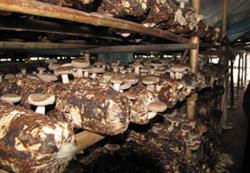
I. Choose a suitable site for summering. A single-story house with a civil-engineering structure, an auditorium, or a warehouse may be chosen, or a shade shed may be built outdoors for summering. Indoors, the requirements are cleanliness, coolness, air convection, and no direct sunlight. For summering in an outdoor shade shed, the requirement is to open water ditches for each bed and around the perimeter, and to cover with film to keep off rain on rainy days.
II. Scientifically arrange the mushroom logs. Arrange the logs in a "#" or "△" shape, with a stacking height of 5-8 layers. Leave a 20-30 cm walkway between each row, with the walkways facing doors and windows to facilitate air flow. The logs must not be placed tightly against the wall; they should be placed at least 20 cm away from the wall. For logs with uneven color conversion, adjust their placement when the temperature is relatively low (maximum temperature below 30°C). Handle the logs gently when adjusting them, and try to avoid severe shaking.
III. Remove the "yellow water" and clean out mushrooms inside the bags. During color conversion of the logs, due to overly strong light or excessively high temperature, the mushroom bags will secrete "yellow water." This is a normal "stress resistance" physiological phenomenon of shiitake mushrooms. A small amount of "yellow water" can be naturally absorbed by the logs. If there is an excessive amount of "yellow water," the logs cannot absorb it themselves, and the "yellow water" accumulates over time and causes rot, resulting in rotten bags. Therefore, thick needles should be used to pierce the bags (without piercing the mushroom skin) to drain the "yellow water." If during the color conversion period there is a sudden long period of low temperature (below 22°C) and a large temperature difference (5-8°C), mushrooms will form inside the bags. If the mushrooms inside the bags have naturally shriveled, no treatment is needed. If the mushrooms inside the bags rot, scrape off the mushrooms inside the bags and the rotten parts, wipe the scraped openings with carbendazim, and then seal the broken areas with transparent tape.
IV. Observe the temperature at all times, and strictly prevent high-temperature burning of the mushrooms. Doors and windows should be blocked with straw curtains or shade nets to prevent direct sunlight, and the shade materials of outdoor shade sheds should be thickened. When the maximum temperature at the site exceeds 33°C, it is very easy to cause log burning. During high-temperature periods, observe the temperature of the summering site at all times, checking once at noon and once in the evening each day. If the temperature is too high, cooling measures should be taken. For indoor summering: spray water on the roof and exterior walls of the summering site in the morning; do not spray water indoors. Strengthen ventilation; during the day, close the doors and windows facing the sun and open the doors and windows facing away from the sun. If the indoor temperature is still too high, promptly move the logs. For outdoor shade shed summering: in addition to thickening the shade materials on the shed roof and around the sides, open ditches inside the shed and irrigate with flowing water to lower the temperature inside the shed. Pay attention to ventilation inside the shed; the shade materials on the side facing the natural wind direction may be appropriately thinned to facilitate air convection inside the shed.