Key Technical Points for Pollution-Free, High-Quality Cultivation of Enoki Mushroom
Enoki mushroom, also known as winter mushroom or golden coin mushroom, gets its name because its fruiting bodies mainly form in winter and appear golden yellow. Enoki mushroom cultivation has a long history and many methods. The following introduces a practical new bag-cultivation technique that offers relatively high economic returns and is simple and easy to carry out. 1. Substrate formulation 1. Sawdust (...
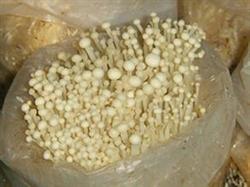 Enoki mushroom can be cultivated in bags, bottles, or beds, but bag cultivation is mostly used, because bag cultivation gives high yields, a short cycle, and low cost, and is suitable for farmers to carry out. How can bag-cultivated enoki mushroom achieve pollution-free cultivation?
1. Reasonably arrange the production season. Enoki mushroom is cold-tolerant and heat-sensitive, and belongs to the low-temperature fruiting type of mushrooms. The suitable temperature for mycelial growth is 3-34°C, and the suitable temperature for fruiting body growth is 5-20°C. Generally, cultivation spawn can be made in September-October, and mushrooms can be produced by mid-November. If considering listing during New Year's Day and the Spring Festival, when consumption is relatively large, the cultivation time can be appropriately postponed.
2. Prepare early. Cottonseed hulls are best for the cultivation substrate, but straw or sawdust can also be used. In addition to the main ingredients, auxiliary materials such as wheat bran, rice bran, or cornmeal are also needed. In addition, calcium carbonate or gypsum powder and sugar are also needed. Generally, the main ingredients make up about 80%, auxiliary materials about 15%, gypsum powder or calcium carbonate 1%, and sugar 1%. The main ingredients can first be pre-wetted with water; the sugar can be dissolved in water and added together with the main ingredients, and the next day the auxiliary materials can be added and mixed together. Enoki mushroom is suited to a slightly acidic medium, and generally no lime or limewater needs to be added. Commonly used enoki mushroom cultivation strains are divided into two major categories: one is light yellow to golden yellow enoki mushroom, such as Hybrid 19; the other is white enoki mushroom, such as Platinum No. 5, No. 6, etc. Yellow enoki mushroom has a wide suitable temperature range, strong adaptability, fast fruiting, and high yield. White enoki mushroom fruits slowly, its disease resistance is also inferior to that of yellow enoki mushroom, and it is not suitable for cultivation in areas and seasons with relatively high temperatures. In addition, preparations must also be made for the mushroom house, sterilization pot, cultivation bags, and insecticidal and sterilizing equipment, etc.:
3. Sterilization and inoculation. For the substrate bags, ethylene or polypropylene bags 35-40 cm long and 14-17 cm wide can be selected. Each bag is filled with 400-500 g of substrate. The bag opening and the surrounding areas must be pressed tight, and about 18 cm of space should be left at the upper part of the bag so that the enoki mushroom can later elongate as it grows. After filling the substrate, tie the top tightly, place upright in an atmospheric pressure sterilization pot, sterilize for 10 hours, then take out and inoculate. The inoculation room must be disinfected, and especially when using open inoculation, inoculation must be carried out free of contaminating microorganisms.
4. Harvest in time. 2-3 days after inoculation, the mycelium begins to germinate, after 7-8 days it spreads through the substrate, and after about 40 days the mycelium can fully colonize it. Once the bags are fully colonized with mycelium, they can either be moved into the cultivation room, or placed on the ground or on mesh racks. Open the bag opening and mushrooms can be produced. After the bag opening is pulled open, moisture evaporates easily, so attention must be paid to moisture retention. When the enoki mushroom has grown to 15 cm high and the caps have not opened, it can be harvested. After each flush is harvested, attention must be paid to scratching the surface to stimulate new mushrooms.