Methods and Key Technical Points for Growing Dictyophora (Bamboo Fungus) on Raw Substrate Without a Shed
How is Dictyophora grown on raw substrate without a shed? Please give an introduction. Dictyophora is known as the "Queen of Fungi" and is a precious edible mushroom in our country. Since the early 1990s, when Gutian County, Fujian Province, first succeeded in cultivating Dictyophora on raised beds under a shade shed in the field, inoculation in spring of the same year was achieved, and after mycelial growth and cultivation the harvest period began. The yield of dried Dictyophora per square meter reached 250-350 grams, with high yields reaching 500 grams. The production cycle was shortened by two thirds, and the yield per unit area increased 10-fold, an efficient result. In recent years, new breakthroughs have been made in cultivation techniques, adopting the "raw substrate, shed-free, multi-form cultivation method," which not only gives stable and high yields, saves labor and materials, and lowers costs, but also broadens the cultivation field and resolves the contradiction of "mushrooms competing with grain for land," bringing about another new leap in Dictyophora production.
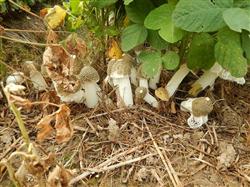
How is Dictyophora grown on raw substrate without a shed? Please give an introduction
Dictyophora is known as the "Queen of Fungi" and is a precious edible mushroom in our country. Since the early 1990s, when Gutian County, Fujian Province, first succeeded in cultivating Dictyophora on raised beds under a shade shed in the field, inoculation in spring of the same year was achieved, and after mycelial growth and cultivation the harvest period began. The yield of dried Dictyophora per square meter reached 250-350 grams, with high yields reaching 500 grams. The production cycle was shortened by two thirds, and the yield per unit area increased 10-fold, an efficient result. In recent years, new breakthroughs have been made in cultivation techniques, adopting the "raw substrate, shed-free, multi-form cultivation method," which not only gives stable and high yields, saves labor and materials, and lowers costs, but also broadens the cultivation field and resolves the contradiction of "mushrooms competing with grain for land," bringing about another new leap in Dictyophora production.
I. Principles of shed-free cultivation on raw substrate:
Through extensive experiments on raw substrate cultivation of Dictyophora, we have established that its mycelium has a strong ability to resist contaminating microorganisms; it can pass through the antagonistic lines of many microorganisms and germinate vigorous mycelium within their communities. Even if the substrate has already been occupied by other organisms, once Dictyophora mycelium comes into contact with it, it can overtake the contaminated substrate, and this is even more pronounced in Dictyophora echinovolvata. According to observations, this is mainly because the extracellular enzymes secreted by Dictyophora mycelium have extremely strong decomposing power, capable of fully decomposing and absorbing the nutrients in the raw substrate, while the vast majority of contaminant spores find it difficult to germinate and colonize on the raw substrate; the resulting strength differential between them gives Dictyophora mycelium a growth and development advantage.
Dictyophora cultivation now mostly uses the high-temperature type Dictyophora echinovolvata. Its fruiting body growth and development period is from June to September each summer. At this time, various crops such as soybean, corn, sorghum, and cucurbits are in their period of luxuriant stems and leaves; in summer, orchards, forest farms, and forest and fruit trees are densely shaded, providing good shade conditions; moreover, the above crops and forest and fruit trees exhale large amounts of oxygen every day, which is very favorable for the growth and development of Dictyophora fruiting bodies. These natural environmental conditions create an organically integrated biological chain for shed-free cultivation of Dictyophora.
II. Raw material selection and treatment:
The raw materials for cultivating Dictyophora fall into "five major categories": 1. Bamboo category: regardless of "size, old or new, dead or alive," bamboo roots, leaves, branches, chips, shavings, and stems, as well as leftovers from bamboo processing factories, can all be used. 2. Miscellaneous wood category: miscellaneous woods that do not contain aromatic oils and fats can all be used. 3. Straw category: apart from rice straw and wheat straw, the straw of other crops can all be used. 4. Wild grass category: more than 10 common kinds such as reed grass, reed, and five-node taro can all be used for cultivation. 5. Shell category: rice husks, peanut shells, corn cobs, and bean shells can all serve as substrate.
Raw material treatment is a key link related to raw substrate cultivation of Dictyophora. Raw material treatment requires the following:
1. Sun-drying: whether bamboo, wood, wild grass, or straw category, all must be sun-dried, because fresh bamboo and wood themselves contain alkaloids; through sun-drying, the living tissues within the material die, and at the same time the alkaloids also volatilize and dissipate.
2. Cutting and breaking: cutting and breaking the raw material is mainly to destroy its integrity, making the plant's living tissues die easily; cut and broken raw material is easily decomposed by mycelium, which absorbs its nutrients.
3. Soaking: raw material soaking usually adopts the alkalization method. Put the bamboo category into a pool; wood chips or other fragments can be packed in gunny bags or woven bags and placed in the pool, then add 0.3-0.5% lime per 100 kg of material, with water to submerge the material as the limit, and soak for 24-30 hours to achieve disinfection and sterilization. After filtering, rinse repeatedly with clean water until the pH value is about 7, then scoop out and drain until the moisture content is 60-70%, and it is ready for production.
4. When using bagasse, cottonseed hulls, corn stalks, soybean, rice husks, peanut stalks, rapeseed stalks, and other straw categories for cultivation, the above proportion of lime water can be sprinkled into the material, left to for 8-10 hours, and then used.
III. Shed-free cultivation forms and techniques
1. Intercropping crops beside Dictyophora beds
(1) Cultivation season: Dictyophora cultivation is generally divided into spring and autumn seasons. Temperatures differ between north and south in our country, so two points should be grasped specifically: first, the temperature at sowing time should not exceed 28°C, suitable for mycelial growth and development; second, in the 2-3 months after sowing during the button development period, the temperature should not be lower than 10°C, so that the buttons grow healthily into fruiting bodies. In the southern provinces, intercropping Dictyophora with crops is usually spring sowing, starting at "Jingzhe," with material piling and sowing, and starting intercropping crops at "Qingming."
(2) Site preparation: first dig drainage ditches well; the bed width is 1 m, and the length depends on the site, generally 10-15 m is best; between beds, set up a walkway 20-30 cm wide; the bed is "turtle-back shaped," 25-35 cm from the bottom of the bed ditch to prevent water accumulation.
(3) Sowing method: Dictyophora sowing adopts one layer of material and one layer of spawn; both spot sowing and broadcast sowing of spawn are acceptable; use 10 kg of substrate per square meter and 3 bottles of spawn, doing the material piling and sowing at the same time.
(4) Covering with soil and mulch: after piling material and sowing, cover the bed surface with a 3 cm thick layer of humus soil, and the moisture content of the humus soil is preferably 18%. After covering with soil, cut bamboo leaves or reeds into small sections and spread them over the surface, and cover the bed with plastic film.
(5) Intercropping crops: 15-20 days after covering soil beside the Dictyophora bed, dig holes beside the bed and sow crop seeds, intercropping one plant at intervals of 50-60 cm.
(6) Field management: after sowing, cultivate for 25-30 days at normal temperature, and the mycelium will climb onto the material surface; the covering film can then be removed, and the bed covered with fern (wolf's clothing) or thatch, which helps small mushroom buttons form. After the mycelium continuously proliferates through cultivation and absorbs a large amount of nutrients, it forms rhizomorphs and climbs onto the material surface, transitioning from vegetative growth to reproductive growth, quickly turning into buttons, and breaking open to produce stalks and form fruiting bodies. During the fruiting period, the moisture content of the substrate is preferably 60%, the moisture content of the covering soil is below 20%, and the relative air humidity is required to be preferably 85%. During the button growth period, water must be sprayed once in the morning and once in the evening to maintain a relative humidity of no less than 85%, preferably 85%. During the button growth period, water must be sprayed once in the morning and once in the evening to maintain a relative humidity of 85%, preferably 85%. As the buttons swell, protrusions gradually appear at the top, and then within a short time they break open, produce stalks, and spread their skirts.
Water spraying for Dictyophora requires "four observations": first, observe the covering material; when the bamboo leaves or straw grass become dry, spray water; second, observe the covering soil; when the covering soil turns white, spray more and frequently; third, observe the buttons; when the buttons are small, spray lightly and as a mist; when the buttons are large, spray more and heavily; fourth, observe the weather; on sunny and dry days with high evaporation, spray more; on cloudy and rainy days, do not spray. Only in this way can you ensure good button growth, good mushroom production, and beautiful fruit body shape.
2. Intercropping Dictyophora in forests and orchards
Using the spaces in orchards such as apple, citrus, grape, oil nai, peach, and pear, as well as the tree spaces in mountain forest land, Dictyophora can be intercropped to improve land utilization. Specific measures:
(1) Preparing beds in the orchard: choose mature fruit forests on flat land or gentle slopes, with humus-containing sandy loam soil, and orchards near a water source. Clear the site of debris and weeds 7-10 days before sowing; it is best to turn the soil and let it bleach in the sun. Bordeaux mixture can be sprayed on the fruit tree heads to prevent diseases and pests. Generally, fruit trees are spaced 3 x 3 m, and the open space between them is used as the Dictyophora cultivation bed. Dig ditches and make beds along the fruit trees, with a walkway spacing of 30 cm, a bed width of 60-80 cm; the soil should not be too finely broken, to facilitate aeration; leave 40-50 cm beside the fruit trees as a passage.
(2) Piling material and sowing: before sowing, pre-moisten the substrate well, with a moisture content of about 60%. On a sunny day, scrape open the top 3 cm of soil on the bed surface, push it to both sides of the bed, and keep it for covering soil; then pile the prepared substrate on the bed, and afterward spot-sow the Dictyophora spawn onto the material. If the tree branches and leaves are not dense, cover the covering soil with a layer of fern and thatch to avoid direct sunlight. After sowing, sprinkle lime or other pesticides in the bed ditches and around the site to kill insects.
(3) Mycelial growth management: 15-20 days after sowing, generally no water spraying is needed; it is best to uncover the film and ventilate for about 30 minutes each day, increasing the number of ventilations later, and keep the substrate moisture content at 60-70%. In the Spring Festival period with much rain, dig drainage ditches well, and the ditches should be 30 cm deeper than the beds. The most suitable temperature for mycelial growth is 23-26°C.
(4) Fruiting management: 40-50 days after sowing, the mycelium can fill the substrate; after 10-15 days, the mycelium reaches physiological maturity and climbs onto the covering soil. At a normal temperature above 20°C, mushroom buttons can grow after 10-15 days of cultivation; at this time maintain a humidity of 80-90%; at normal temperature, after 20-25 days of cultivation, the buttons mature and can then be harvested.
3. Bionic cultivation of Dictyophora on bamboo stumps without substrate
Generally, the method of sowing in old bamboo holes on site is adopted. Choose moso bamboo stumps that have been cut for more than 2 years, dig a hole on the uphill side beside the bamboo stump, 5-6 cm in size and 20-25 cm deep; fill the hole with a 5 cm thick layer of decayed bamboo leaves. After sowing one layer of Dictyophora spawn, fill another 10 cm thick layer of decayed bamboo leaves, then sow another layer of spawn, and in this way fill and sow 2-3 layers, finally covering with decayed bamboo leaves and the soil dug out to a thickness of 2-3 cm, and gently tread it firm. If the soil is dry, water it to increase moisture, and cover with weeds, branches, and leaves to shade the sun and block the wind, preserving moisture and heat. When sowing the spawn, note to sow less in the lower layers and more in the upper layers, so that after the mycelium recovers it better moves toward the dead bamboo rhizomes. Alternatively, in the bamboo forest, from high to low, dig a small ditch every 25-30 cm, 7-10 cm deep, place a little decayed bamboo or bamboo rhizome at the bottom of the ditch, scatter spawn on it, and then cover with soil. Generally, each mu of moso bamboo forest has 180-200 old bamboo stumps; digging out the stumps costs labor and money, and leaving them makes them hard to rot; using them on site to cultivate Dictyophora can decompose the bamboo stumps, achieving two goals at once. Using old bamboo stumps to cultivate Dictyophora relies entirely on natural environmental conditions, so sowing in spring from March to April is best, when spring returns to the earth and the temperature and soil moisture are suitable for mycelial growth.
Dictyophora is neither drought-tolerant nor waterlogging-tolerant, so the hole drainage ditches must be kept clear. In drought, water to preserve moisture, preferably not less than 60%. In winter, water once every 15-20 days; in summer, once every 3-5 days. Watering should not be too rapid, to prevent scattering the surface covering leaf layer. The soil moisture content should always be maintained at 15-18%. Every year a certain number of bamboo must be cut to increase bamboo rhizome humus, so that the mycelium has a new nutrient source every year. Every winter the soil must be cultivated once, removing weeds and loosening the soil, so that the mycelium gets a certain amount of oxygen.
Click to get more Dictyophora cultivation techniques
Click to get more edible mushroom cultivation techniques