What is the rice stem borer (Chilo suppressalis)? Detailed control methods
What is the rice stem borer and how to control it? Please provide an introduction and control methods. The rice stem borer, also known as the stem maggot, is distributed in rice-growing areas across both southern and northern China. Its hosts include rice, corn, sugarcane, foxtail millet, broad bean, water bamboo, sorghum, rapeseed, wheat, Chinese milk vetch, and others. In recent years, damage from this pest has remained severe....
What is the rice stem borer and how to control it? Please provide an introduction and control methods
The rice stem borer, also known as the stem maggot, is distributed in rice-growing areas across both southern and northern China.
Its hosts include rice, corn, sugarcane, foxtail millet, broad bean, water bamboo, sorghum, rapeseed, wheat, Chinese milk vetch, and others. In recent years, damage from this pest has remained severe.
Damage characteristics: When rice is attacked at the tillering stage, dead heart seedlings and dead leaf sheaths appear; when attacked at the booting and heading stages, dead boot ears and white ears appear; when attacked at the grain-filling and milk-ripe stages, half-dead ears and insect-damaged plants appear, with increased numbers of empty grains, and the plants are prone to lodging and breaking in strong winds. For the dead heart seedlings caused by rice stem borer damage, the larvae first gather inside the leaf sheath and bore to feed, water-soaked yellow spots appear on the outside of the leaf sheath, and afterward the leaf sheath turns withered yellow and the leaves gradually die, which is called the dead tip stage. After the larvae bore into the rice stem, the tip of the flag leaf turns yellow, and in severe cases the central leaf withers and dies. The damaged stem has boring holes, with very little frass outside the holes but abundant frass inside the stem; the frass is yellow, and the rice stalk breaks easily. This differs from the dead heart seedlings caused by damage from the greater rice stem borer and the yellow stem borer.
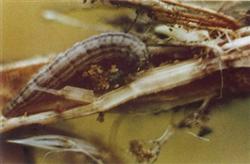
Morphological characteristics: The adult female moth has a body length of 14-16.5 mm and a wingspan of 23-26 mm, with filiform antennae; the forewings are grayish yellow, nearly rectangular, with 7 small black spots along the outer margin; the hindwings are white, and the abdomen is grayish white and spindle-shaped. The adult male moth has a body length of 13-15 mm and a wingspan of 21-23 mm; the forewings have 1 black spot in the center with 3 small black spots below it, and the abdomen is slender and cylindrical. The egg is 1.2 mm long, flat and oval; the egg mass consists of dozens to 200 eggs arranged in a fish-scale pattern, measuring 13-16 mm long and 3 mm wide, and is milky white to yellowish white or grayish yellow-brown. The larva has about 6 instars. The mature larva has a body length of 20-30 mm; the head is red-brown except for the brown upper mandible, and the whole body is light brown with red-brown stripes. The pupa is 10-13 mm long and cream yellow to light yellowish brown or brown. In the [certain] region there are 3-4 generations; in areas at 20-24°C there are 4-5 generations; in areas above 24°C there are 5-6 generations. It overwinters as larvae of the 4th instar or older in rice stubble, rice straw, or inside the stems of other hosts, in weed clumps, in soil crevices, and other places. Pupation begins when the temperature rises above 11°C, and adult emergence occurs at 15-16°C. Larvae younger than the 4th instar mostly bore into the aboveground rice stubble and the stems of winter crops such as wheat, barley, broad bean, and rapeseed the following year when the soil temperature rises above 7°C; when the average temperature reaches 10-15°C, they enter the peak migration period, moving into the stems of winter crops and continuing to feed on the inner wall; when they develop to maturity, they bite an emergence hole in the inner wall of the host, leaving only the epidermis, and after emergence they break through the membrane and bore out. It is phototactic and prefers to lay eggs on the leaves of young seedlings; after stem elongation and jointing, it lays eggs on leaf sheaths that are broad-leaved, thick-stemmed, and tender green; newly hatched larvae first bore into the leaf sheath and gather to cause damage, causing dead sheaths; after the 2nd-3rd instar they bore into the stem, and after the 3rd instar they move between plants to cause damage. This pest has strong vitality, a mixed diet, and tolerance to drought, moisture, and low temperatures. Its main natural enemies include egg parasitoid wasps and others.
Click to get more insecticide application techniques
Click to get more pesticide application techniques