Pest and Disease Control Methods for Bamboo Fungus After Flooding
How to prevent and control pests and diseases in bamboo fungus cultivation after a disaster? The pathogens that commonly occur in bamboo fungus cultivation after flooding are: slime molds and sooty mold fungi; the pests are: slugs, termites, mites, etc. The control methods are described below for the reference of mushroom growers.
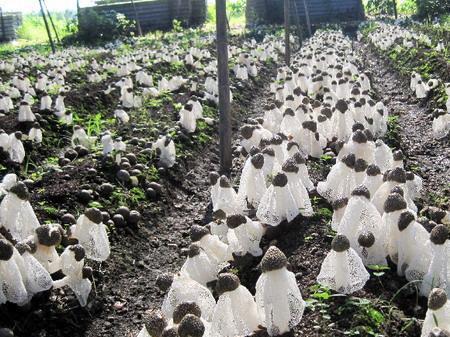
1. Slime molds occur on the exposed soil of the bamboo fungus bed or on the covering rice straw. In the early stage they are slimy, capable of deformation and movement, and appear milky white, orange-yellow, or yellow-green, causing mycelial growth to be inhibited or gradually die out; in severe cases, bamboo fungus no longer grows. When bamboo fungus primordia are harmed, they become water-soaked and rot. Control measures: strengthen ventilation. In the early stage, spray with carbendazim, 70% thiophanate-methyl at 1000 times, copper sulfate at 1:500, or 10% bleaching powder 3-4 times consecutively.
2. Sooty mold fungi often occur in high-temperature and high-humidity environments. In the early stage, dirty-white fluffy mycelium appears on the casing soil layer of the bamboo fungus bed, quickly turning pink and black; the colony becomes dark smoky gray and produces large amounts of black spores. It mainly harms bamboo fungus mycelium, causing the mycelium to break and eventually die. Control method: the early appearance of dirty-white fluffy mycelium is the best time for treatment; at this point, spray 3% carbolic acid or 2% formaldehyde directly on the affected area. When black spores appear, spray with 20 times formalin plus thiophanate-methyl (70%) wettable powder diluted 700 times. In severe cases, dig out and cut off the substrate around the affected area, spread fresh lime on and around the affected area, and cover the affected area with plastic film to control its spread.
3. Slugs are a type of mollusk, commonly known as "snails without shells"; they have no shell, with the body exposed, and mainly devour bamboo fungus primordia, causing perforation of the primordia and leaving a trail of white mucus. Control method: use a 1:50:50 mixture of calcium arsenate, wheat bran, and water placed where slugs frequent to trap and kill them, or spray 5% cresol soap solution or 50% salt water drops where slugs frequent to kill them.
4. Termites: the common termites that harm bamboo fungus are Coptotermes formosanus, Odontotermes formosanus, and Macrotermes barneyi. They can bore into and feed on bamboo fungus mycelium, affecting bamboo fungus yield. Control method: track down the termite nest and main termite trails, and apply a poison formulated from 80% arsenious acid, 15% salicylic acid, and 5% iron oxide; spraying 6-15 g per nest can kill the entire nest.
Mites are prone to outbreaks under high temperature and high humidity. They occur during both the bamboo fungus mycelial growth stage and the mushroom fruiting stage. They can bite off the mycelium, causing it to shrink and stop growing, and can also bite the bamboo fungus primordia and transmit pathogens; in severe outbreaks they cause total crop loss. Control method: spray with 2.5% bifenthrin at 2000 times dilution or other specialized acaricides.