Detailed Explanation of Lotus Root Planting Techniques and Field Management Key Points
Lotus root is slightly sweet and crisp, can be eaten raw or cooked, and is one of the common table vegetables. Lotus root is also a plant with fairly high medicinal value; its roots, leaves, flower stamens, and fruits are all treasures and can all be used as nourishing medicine. Lotus root powder made from lotus root can aid digestion and stop diarrhea, stimulate appetite and clear heat, nourish and tonify the constitution, and prevent internal bleeding. It is an excellent liquid food and nourishing delicacy for women, children, the elderly, and those who are frail and prone to illness. Lotus root is rich in vitamin C and minerals, has medicinal effects, benefits the heart, and has the effect of promoting metabolism and preventing rough skin.
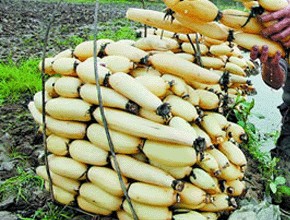
>> Planting Techniques for Shallow-Water Lotus Root and Deep-Water Lotus Root :
I. Shallow-Water Lotus Root
1. Select excellent seed lotus root. For shallow-water lotus root, excellent varieties suitable for shallow-water cultivation should be selected as seed lotus root, such as Hainan Zhou, Wulian No. 2, etc. The seed lotus root should preferably be a whole lotus root with more than 3-4 nodes and with both daughter lotus roots and granddaughter lotus roots complete. The seed lotus root is required to be thick and strong, with vigorous buds, free of pests and diseases, and free of damage.
2. Select fertile clay loam field plots. The product organ of lotus root is formed in the underground soil. Therefore, the lotus root field for planting shallow-water lotus root should be one that can retain water, is rich in organic matter, has a deep silt layer, and is most suitable if it is fertile clay loam.
3. Reasonable close planting. The planting density of lotus root is closely related to maturity period and yield. Appropriate close planting has the effect of early maturity and increased yield. Generally, the density for early-maturing varieties is: row spacing 2 m, hole spacing 0.7 m. Late-maturing varieties should be appropriately sparsely planted, with the density being: row spacing 2-2.5 m, hole spacing about 1 m.
4. Place equal importance on base fertilizer and topdressing. Lotus root has a long growth period and requires much fertilizer. The general principle for fertilizing shallow-water lotus root is to place equal importance on base fertilizer and topdressing. Generally, 1500-2500 kg of human and livestock manure or barnyard manure per mu is applied as base fertilizer. For early-maturing lotus root, generally 1500-2000 kg of human excrement and urine fertilizer per mu is applied as topdressing. Topdressing is applied three times, with emphasis at the early stage of lotus root formation.
5. Scientifically regulate the water level. The general principle for water layer management of shallow-water lotus root is shallow at the front, deep in the middle, and shallow at the back. During the germination and growth period, the water layer should be shallow, preferably 4-7 cm. During the period of vigorous stem and leaf growth, the water layer should be deeper, preferably 12-15 cm. During the lotus root formation period, the water layer should be shallow, preferably 4-7 cm.
6. Frequently turn the lotus root tips and weed in time. During the period of vigorous stem and leaf growth of lotus root, the lotus rhizome grows rapidly. When the curled leaf is about 1 m from the field edge, in order to prevent the lotus root tips from crossing the field ridge, turn the lotus root tips near the field ridge back into the field every 2-3 days. The lotus root tips are very tender, so the soil should be turned together with the lotus root tips to prevent breaking the lotus rhizome, and after turning, press the soil back firmly. It is best to turn the lotus root tips at noon. In the early growth stage of shallow-water lotus root, there are many weeds, which greatly affect the growth of lotus root, so weeds should be removed in time, preferably by combining manual weeding and chemical weeding.
7. Harvest at the right time. After the terminal leaf of lotus root appears, when the back of the terminal leaf is slightly red and the edge of the basal standing leaf begins to turn yellow, the lotus root is fully mature. It can then be dug up and sold on the market.
II. Deep-Water Lotus Root
1. Select excellent varieties and seed lotus root. For deep-water lotus root, excellent varieties suitable for deep-water cultivation should be selected, such as Simiao, Jingtang Silk Lotus Root, etc. Select whole lotus roots or larger daughter lotus roots that have the excellent characteristics of this variety and relatively thick rear stem nodes as seed lotus root. The seed lotus root must be fresh, thick and strong, complete and intact, with at least 2 fully mature lotus root sections and intact terminal buds.
2. Select suitable water surfaces. For deep-water lotus root, shallow lakes, river bends, areas with gentle water flow, stable rise and fall, and underwater silt layers more than 20 cm thick should be selected. The maximum water level during the summer flood season should not exceed 120 cm.
3. Properly prepare the land and reasonably apply base fertilizer. Before planting deep-water lotus root, if conditions permit, the field should be plowed and harrowed with water. If the water level is relatively deep and it is inconvenient to plow and harrow, a large shovel can be used to properly level the field soil. Apply 1500-2000 kg of composted barnyard manure or 2500 kg of fresh green manure per mu as base fertilizer, and the base fertilizer should be plowed and harrowed into the soil. Deep-water fields are prone to phosphorus deficiency, so it is best to apply 20-30 kg of calcium superphosphate per mu to promote strong seedlings and early development.
4. Plant at the right time. Because the water level is deeper and the soil temperature rises slowly, the planting period should be delayed by 10-15 days compared with shallow-water lotus root.
5. Solid topdressing. In deep water, fertilizer is easily lost, so liquid fertilizer should not be applied. When topdressing, barnyard manure or green grass should be buried into the mud. If chemical fertilizer is used as topdressing, the chemical fertilizer should be fully mixed with river mud, made into mud balls, and applied into the lotus root field.
6. Prevent waterlogging and wind waves. The water level of deep-water lotus root is not easy to regulate. When the flood season arrives, if the standing leaves are submerged, emergency drainage should be carried out within 8 hours to make the lotus leaves emerge above the water surface so as to prevent drowning. Deep-water lotus root is easily affected by wind waves. In particular, being hit by typhoons during the lotus root formation period often causes serious yield reduction. Therefore, several rows of wild rice stem can be planted around the lotus root field to prevent wind waves and wind damage.
7. Harvest at the right time. Deep-water lotus root is mostly late-maturing varieties, and tender lotus root is not harvested. When all the standing leaves turn yellow, the lotus root can be dug up and sold on the market.