The Latest Cultivation Techniques, Formulas and Planting Times for Wine Cap Stropharia (Stropharia rugosoannulata): A Detailed Guide
Do you know how to grow wine cap stropharia? Would you like to grow it yourself? Below we introduce a simple yet high-yielding cultivation method. Let's take a look.
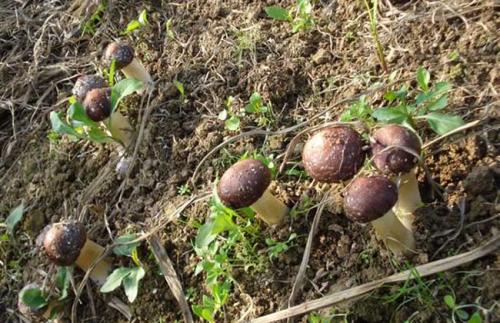
1. Substrate preparation: rice straw 100%, plus wheat bran or rice bran 10%, cornmeal 5%, gypsum powder 2%, superphosphate 1%, lime powder 2%, fertile garden soil 10%, moisture content 70%-75%, pH 6-65.
2. Raw material treatment: Before building the pile, the rice straw must first absorb enough water. The moisture content should reach 70%-75%. The standard is: take a small representative handful of straw and wring it tightly; water drips out, but the drips break into separate drops. This indicates the moisture content is suitable, and then the pile can be built for fermentation. Two days before fermentation, mix the other auxiliary materials evenly. Wet them with a 1:500 dilution of carbendazim solution, cover with plastic film and let them sit for 2 days. Add the auxiliary materials into the pile in layers; the straw pile should be firm and compact. Turn the pile once after 3 days, then pile for another 2-3 days before moving it to the cultivation site to spread the substrate and sow the spawn.
3. Cultivation method: Outdoor cultivation with raw substrate in a simple plastic shed is more suitable. This is because outdoor raw substrate cultivation has low cost and is easy to operate.
4. Cultivation season: In most areas of the middle and lower reaches of the Yangtze River, two crops can be grown per year, namely one crop from September to December and one from December to May. North of the Yellow River and in high-altitude mountainous areas, the cultivation period can be advanced appropriately, and the ending period can be postponed appropriately.
5. Site preparation and disinfection: Make the bed slightly higher in the middle and slightly lower on both sides. The topsoil dug out can be piled on one side for use as casing soil. Drainage ditches should be dug around the perimeter. After the bed is built, splash 1% tea seed cake water onto the bed and spray insecticide to prevent pests such as earthworms.
6. Spreading substrate and sowing spawn: Spread 20 kg of dry straw per square meter and sow 2 kg of spawn. Spread one layer of substrate, then sow one layer of spawn, each layer about 12 cm thick. Shape the substrate into a trapezoid and press it firm so it can be covered with soil. Then cover the substrate surface with plastic film, and cover the film with a straw mat for shade.
7. Management during the mycelial growth period: During the mycelial growth period, the substrate temperature should be controlled at 22-28°C, and must not exceed 32°C; the substrate moisture content should be 70%-75%; the relative air humidity should be 85%-90%.
8. Casing soil: 25-30 days after sowing, when the mycelium has connected between the holes and the mycelium in the substrate has nearly grown through the substrate, casing soil can be applied to the substrate surface. The casing soil should be fertile loam rich in humus, loose, and with good granular structure. The casing soil thickness should be 3-4 cm.
9. Management during the fruiting period: After the mycelium has fully colonized the substrate and casing soil has been applied, mushrooms can appear in 15-20 days.