Key points of high-yield techniques for cultivating shaggy ink cap mushrooms (Coprinus comatus) with distiller's grains
Distiller's grains are a good raw material for cultivating edible fungi. Their nutrient composition is suitable for the mycelial growth of shaggy ink cap mushrooms (Coprinus comatus) and other fungi, which can both reduce the cost of edible fungus production and help solve environmental pollution. Distiller's grains contain a small amount of ethanol and active yeast that are harmful to mycelial growth, and are highly acidic, with a pH of about 3-5. Choose fresh...
Distiller's grains are a good raw material for cultivating edible fungi. Their nutrient composition is suitable for the mycelial growth of shaggy ink cap mushrooms (Coprinus comatus) and other fungi, which can both reduce the cost of edible fungus production and help solve environmental pollution. Distiller's grains contain a small amount of ethanol and active yeast that are harmful to mycelial growth, and are highly acidic, with a pH of about 3-5.
Choose fresh distiller's grains and combine them with other materials. The formulas are:
1. 90% distiller's grains, 8% lime, 1% gypsum, 1% ammonium bicarbonate, biological efficiency 120%-130%. 2. 39% distiller's grains, 39% corncobs, 10% rice bran, 8% lime, 2% gypsum, 1% superphosphate, 1% ammonium bicarbonate, biological efficiency 130%. 3. 50% distiller's grains, 30% cottonseed hulls, 8% wheat bran, 8% lime, 2% gypsum, 1% superphosphate, 1% ammonium bicarbonate, biological efficiency 130%.
1. Mixing the substrate: Mix the lime, gypsum and ammonium bicarbonate directly into the distiller's grains, adjusting the pH to 9-11. The other materials (cottonseed hulls, corncobs) are still prepared according to the formulas for oyster mushrooms and shaggy ink cap mushrooms, then evenly mixed into the distiller's grains and fermented for 5-8 hours. Spread out to cool, then bag. The mixing must be even, and the pH must be raised to 9-11 in the early stage.
2. Select high-quality, high-yield strains and use high-quality spawn: A superior strain is the primary condition for high yield and the prerequisite for high yield. Moreover, good-quality spawn has strong vitality, a strong ability to decompose the substrate, fast mycelial growth, wide adaptability, strong stress resistance and a high mushroom-forming rate. 3. Bagging and spawning: After the substrate is adjusted, choose 50×26 polyethylene bags and use the layered spawning method, that is, three layers of substrate and four layers of spawn. Spread the spawn evenly at both ends of the bag, and place the two middle layers of spawn close against the outer sides of the plastic bag. After bagging, poke 3-4 holes in each spawn block with a hand sewing needle to allow ventilation. The number of layers of bags stacked is determined by the air temperature. The optimum temperature during the mycelial growth period is 23°C-26°C; at this temperature the mycelium grows fastest and it is unsuitable for the growth of contaminant fungi. For safe mycelial growth, the incubation temperature is best kept somewhat lower, which neither hinders mycelial growth nor inhibits the growth of contaminant fungi.
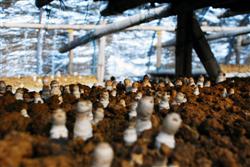
4. Management during the fruiting period: After a 30-35 day mycelial growth period, management during the fruiting period can begin. The sunken beds in the shed must be sterilized and treated against insects in advance. First pile and cover the soil to be used with a mixture of 2% formaldehyde and 1% dichlorvos for 24 hours, then add 2.5 kg of lime, 2.5 kg of plant ash and 1 kg of phosphate fertilizer per 2 cun of soil and mix well. Remove the film from the fully colonized bags of shaggy ink cap mushrooms or oyster mushrooms and lay them horizontally in the sunken beds, cover well with soil to a thickness of about 4 cm, then spray one heavy watering, and then cover with a small arched tunnel. During this period, pay attention to adjusting the air humidity and temperature. The suitable temperature during the fruiting period of shaggy ink cap mushrooms is 13°C-26°C, and the air humidity is about 85%. After about 10 days, when aerial mycelium grows on the soil surface, ventilate at regular intervals and spray water at the same time. The principle of watering is to spray little and lightly. After fruiting bodies appear, do not spray water directly; at this time increase the air humidity and strengthen ventilation. Before ventilating, the mushroom house should be sprayed with water first. Practice has proved that in the specific management of watering during the fruiting period, one should follow the scientific water-use method of not spraying the fruiting bodies at the bud stage, spraying the air frequently, spraying moderately when the stipes are visible, keeping things moist, and spraying lightly when caps appear.
5. Harvesting: Shaggy ink cap mushroom fruiting bodies are best picked when 70% mature, giving good quality and high yield. When harvesting, hold the base with your hand, turn it left and right, then pull it out gently, taking care not to pull out the soil at the base. After harvesting, clean the bed surface promptly and do not leave residual mushrooms. Spray the bed surface once or twice a day with "maintenance" water to keep the soil layer moist; do not spray too much water until the next batch of mushrooms appears. Generally 4-5 batches of mushrooms can be harvested. After harvesting, shaggy ink cap mushrooms should be sold or processed promptly; generally, the caps open two days after picking and they lose their commercial value.