Several key issues to grasp in king oyster mushroom cultivation
King oyster mushroom, also known as Pleurotus eryngii, is one of the rare edible fungi. Its flesh is thick and plump, crisp and tender, milky white in color, delicious in taste, and rich in nutrients, and it is hailed as "the meat among vegetables." Using the following new technique of indoor fruiting with outdoor casing soil cultivation, the biological efficiency can reach 100%-120%, and the mushroom bodies have good commercial quality, compared with cultivation without casing soil...
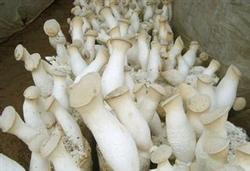 I. Grasp the optimal fruiting period of king oyster mushroom
King oyster mushroom has been cultivated in Panjin, Liaoning for several years now, and the experience gained is that the most suitable fruiting period for producing king oyster mushroom in local mushroom sheds is from early March to the end of April in spring, and from late September to early November in autumn. Without heating facilities, the shed temperature during this period is exactly the most suitable temperature for the growth of king oyster mushroom fruiting bodies, and it is also the period that brings the best economic benefits to king oyster mushroom growers.
II. Make king oyster mushroom spawn at the right time
When first cultivating king oyster mushroom, starting stock spawn production at the beginning of autumn, then producing planting spawn and fruiting bags, by the time the fruiting bag mycelium is fully grown and ready for fruiting, the optimal fruiting period of king oyster mushroom has already been missed, affecting yield and quality to varying degrees, increasing costs, and reducing economic benefits. After several years of research and exploration, a solution has been found. For autumn cultivation of king oyster mushroom, starting at the beginning of autumn, first, use well-isolated anti-aging mother spawn to directly produce stock spawn and fruiting bags; or use well-isolated anti-aging mother spawn to directly produce planting spawn and fruiting bags. For spring cultivation of king oyster mushroom, from December of the previous year to January of the current year, use well-isolated anti-aging mother spawn to directly produce stock spawn and fruiting bags; or produce planting spawn and fruiting bags, while also considering that the temperature in this season is low, so the spawn production time should be appropriately advanced according to the situation. In this way, the spawn-running time is omitted, and the optimal fruiting period of king oyster mushroom is precisely grasped. This brings growth in economic benefits.
III. Improve the inoculation method for king oyster mushroom
At present, most king oyster mushroom cultivation uses plastic bags, generally inoculating at one end of the plastic bag or at both ends of the plastic bag. Especially with manual bag filling, the drawback is that mycelium growth is inconsistent between the inside and outside; after the outer mycelium has fully grown, the inside still needs a few more days. To overcome this drawback and improve the inoculation method for king oyster mushroom, hole inoculation is adopted, inserting the spawn 2 to 3 cm deep into the substrate, filling the hole opening completely without leaving gaps, inoculating four holes per bag, and sealing with breathable stickers. In this way, after the spawn at both ends of the bag germinates, it quickly covers both ends of the bag tightly, and the entire bag takes on a fully surrounding pattern, with mycelium inside and outside growing simultaneously. After three trials, bags inoculated by hole inoculation under the same cultivation bag conditions were fully colonized one week earlier than with the conventional inoculation method. This inoculation method is easy to operate and causes less contamination. King oyster mushroom growers can experimentally change one-end or two-end inoculation to hole inoculation.
Precautions: 1. When filling the substrate, be sure to tie the bag opening tightly. 2. Whether inoculating in an inoculation box or an inoculation tent, disinfect and sterilize in the same way as the conventional method. 3. Disinfect with alcohol over an area larger than the hole-punching range, and seal the opening immediately after inserting the spawn.