Detailed Explanation of Key Management Points for Button Mushroom (Agaricus bisporus) Autumn-Winter Mushroom Shed
Preventing spawn degeneration can increase yield, reduce the occurrence and development of pests and diseases, and decrease pesticide use, which is the foundation for producing organic button mushrooms. 1. The environmental temperature for culturing spawn must not exceed 28°C, and properly cultured spawn should not be stored at room temperature for more than half a month. 2. Effectively master the medium's...
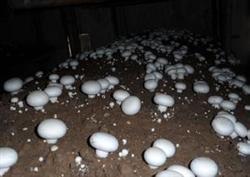 When the button mushroom compost layer is fully colonized, only when the casing soil layer has well-grown, sufficiently developed but not overgrown reticulate mycelium can good mushrooms be produced in abundance. Therefore, mycelium running management after casing is very important, even more so than mycelium running in the compost layer.
1. After the casing soil has been watered to the proper moisture and the surface water traces have dried off, maintain the shed temperature at 22°C-23°C and relative humidity at about 85%. For the first 5 days, keep doors and windows slightly ajar with minimal ventilation as the main approach, supplemented by appropriate ventilation for air exchange, so that the mycelium in the compost quickly grows into the soil layer. Under normal conditions, mycelium will grow into the casing layer within 5 days after casing. After 5 days, gradually increase the ventilation volume, but the air volume should still be determined by the state of the mycelium. If the mycelium is grayish-white, it indicates that ventilation and air exchange are moderate. If the mycelium is fine and white, it indicates insufficient ventilation and air exchange, so increase the frequency and duration of ventilation. However, also prevent excessive ventilation that causes the mycelium to retreat and collapse, forming deep "landmine mushrooms" in the lower part of the soil layer. At the same time, once the mycelium has grown into the soil layer, generally no more watering should be done, because improper watering may also cause the mycelium to droop and produce landmine mushrooms. In addition, pay attention to nighttime temperatures. If the nighttime temperature is below 20°C and the mycelium has just grown into the soil layer, do not ventilate either. If the soil is somewhat dry and unfavorable for mycelium to run through the soil, appropriate watering is also needed, using light and frequent spraying to adjust the soil layer to the proper moisture. If the mycelium has not yet grown into the soil layer 5 days after casing, a layer of plastic film can be placed over the mushroom bed to help draw the mycelium into the soil.
2. The period from 15-20 days after casing is the critical management stage. When the mycelium has run through 2/3 of the casing soil layer and a large amount of mycelium appears in the soil layer, promptly increase the ventilation volume, adjust the shed temperature to 16-18°C, and lower the compost temperature to 15-19°C. At the same time, after 1-2 days of heavy ventilation, spray some "mushroom-setting water," then ventilate heavily for another 1-3 days, then switch to light ventilation to promote primordium and mushroom bud formation. The mushroom-setting water should be sprayed until the soil particles can be pinched flat, rolled round, and are not sticky to the touch. When the young buds grow to the size of soybean (4488, 18.00, 0.40%), spray a "quality-preserving water" once, and after another 4-6 days, the soybean-sized mushroom buds can grow into grade mushrooms with a cap diameter of 2.5-4 cm.
3. Generally speaking, during the fruiting period, the moisture of the soil layer should meet the standard that soil particles can be pinched flat, rolled round, not sticky to the hand, do not crumble when dropped, and water does not leak into the compost. If the soil layer moisture reaches the degree of being able to be rolled round and sticky to the hand, it indicates that the water content is already too high. If fruiting has already begun in October when temperatures are still high, the soil layer moisture can reach the degree of being rolled round and slightly sticky to the hand during the first flush. However, after entering November, the soil layer moisture must never reach the degree of being slightly sticky to the hand, and the soil layer moisture should be gradually reduced to avoid water damage to the mycelium.
4. When the mushroom cap grows to 3-4 cm, it should be harvested promptly. At this time, the mushroom quality is good, the flush turnaround is fast, and the yield is high. If harvested too late, the mushrooms grow too large, which will greatly delay the next flush and will not increase the yield.