Why can't the fermentation of button mushroom compost be overlooked?
In recent years, the sales of button mushrooms have been improving year by year. Combined with the abundance of crop straw in the north, developing button mushroom production in rural areas is a very good path to increasing income. However, the instability of button mushroom yields has constrained the development of this industry. Therefore, to do this industry well and make it big, it is necessary to solve the techniques for high quality and high yields of button mushrooms...
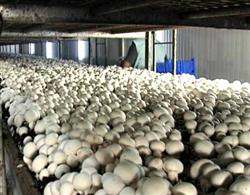 The quality of compost fermentation directly affects button mushroom production. In button mushroom compost fermentation, many mushroom growers neglect the fermentation of the compost, thereby causing declines in yield and quality. When cultivating button mushrooms, the following points should be mastered in compost fermentation:
Fermentation time The better fermentation time is in early August, because fermenting the compost at this time can take advantage of the favorable condition of autumn temperatures going from high to low, strive for a longer fruiting period, and achieve better returns. favorable condition of temperatures going from high to low, strive for a longer fruiting period, and achieve better returns.
Selection of compost All compost materials are required to be fresh and must not be moldy.
Fermentation First, the compost must be fully pre-wetted to avoid the phenomenon of insufficient water absorption by the compost. Second, the building of the pile must be scientific, and a north-south orientation should be adopted, with a pile width of 1.8-2 m and a height of 1.5-1.8 m, and bricks used in the lower layer to build ventilation channels. According to the piling requirements, stack one layer of material and one layer of manure, while keeping the moisture content of the compost at about 65%. Third, note that turning the pile must be reasonable. If one-time fermentation is adopted, the pile must be turned 4 times, counting the days from the start of piling: the first turning on the seventh day, then the sixth day, the fifth day, and the fourth day, and immediately dismantle the pile and move it into the house when fermentation ends; if two-stage fermentation is adopted, the pile must be turned 3 times, respectively on the fifth day, the fourth day, and the third day. When turning the pile, the manure and straw and the inner and outer layers of material should be made uniform and consistent to prevent under-fermented material, while also noting that the moisture content of the compost is always kept at about 65%. Fourth, the compost must be protected from rain; cover it with plastic film when it rains and remove it when the rain stops to prevent the material from becoming suffocated.
Correctly mastering the maturity of the compost The compost for cultivating button mushrooms is best when semi-decomposed. Semi-decomposed compost has the following four characteristics: First, the color of the manure and straw changes from golden yellow or yellow-green to brown, but not black, and there is no manure odor, sour odor, or putrid smell. Second, the straw stems are soft; when pulled by hand there is a certain resistance and elasticity, rather than breaking easily with a light pull, and certainly not decomposed to the point where the straw stems cannot be recognized. When the compost is gripped in the hand, it can be formed into a ball, and after releasing the hand it can naturally crumble. Third, on the fifth day after the last turning of the pile, the temperature of the compost remains above 50°C, but must not exceed 60°C. Fourth, the volume of the compost pile shrinks by 40% compared with the original, the weight decreases by 30%, the moisture content is about 60%, and when pinched by hand no water droplets appear between the fingers.