How to prevent dry bubble disease early in button mushroom cultivation
Dry bubble disease is one of the main diseases of button mushrooms. The pathogen infects during the spawn-running stage and grows in sync with the button mushroom mycelium, but does not show symptoms for the time being; the mycelium invades during the fruiting stage. Affected caps develop dark brown depressions and are covered with white powder; the stipes are uneven in thickness and develop abnormally; diseased mushrooms have no water soaking, no slime and no foul odor, and eventually dry up. The pathogen survives in soil for a long time and spreads through many routes, so prevention should start with substrate processing.
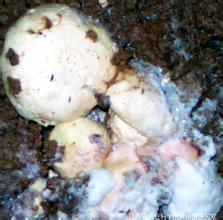
Dry bubble disease is one of the main diseases of button mushrooms. The pathogen infects during the spawn-running stage and grows in sync with the button mushroom mycelium, but does not show symptoms for the time being; the mycelium invades during the fruiting stage. Affected caps develop dark brown depressions and are covered with white powder; the stipes are uneven in thickness and develop abnormally; diseased mushrooms have no water soaking, no slime and no foul odor, and eventually dry up. The pathogen survives in soil for a long time and spreads through many routes, so prevention should start with substrate processing.
1. Select high-quality, highly resistant spawn. Limited by technical conditions, it is not yet possible to virus-free this spawn, so highly resistant spawn of the appropriate age should be introduced.
2. Disinfect the spawn culture room and the mushroom shed. Thoroughly clean the inside and outside, spray the fungicide Baibing Quwuzong solution twice, and use phoxim in appropriate amounts to control insects.
3. Carry out secondary fermentation of the substrate. Pathogen spores germinate during the earlier fermentation and are easily killed during secondary fermentation; although the cost is slightly higher, it prevents trouble before it occurs.
4. Management during the growing period. During the spawn-running stage, spray agents such as mushroom disease-killing liquid once every 3-7 days to suppress external pathogens. During the fruiting stage, strictly regulate conditions such as water, air, temperature and light, especially keeping the moisture content of the casing soil layer and the ventilation rate inside the shed at suitable levels, and persist in spraying chemicals to prevent external pathogens.
5. Treatment after disease onset. If fruiting bodies are found to be affected by dry bubble disease, clear the fruiting bodies and casing soil material over an expanded area of 1-2 m, soak all tools brought into the shed in a 20-fold dilution of formalin for 3 hours, then put them into 5% lime water for disinfection; treat newly applied casing soil material with Baibing Quwuzong; spray Baibing Quwuzong once over the entire floor of the mushroom shed; strengthen insect control measures; burn or deeply bury the diseased remains and casing soil material; and spray carbendazim on the outside of the shed and on the walls.