Introduction to a New Method for Short-Cultivation of Bailing Mushroom (Pleurotus nebrodensis)
After the Bailing mushroom (Pleurotus nebrodensis) bags are fully colonized with mycelium, they cannot fruit directly like oyster mushrooms do; they must go through a mycelial maturation period before fruiting is possible, and this maturation period often becomes a technical obstacle that many mushroom growers find hard to overcome. Depending on the mycelial characteristics, this stage generally takes about 30-60 days, with some strains even taking as long as about 80 days...
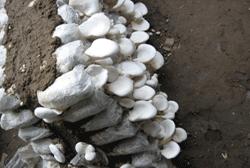
After the Bailing mushroom (Pleurotus nebrodensis) bags are fully colonized with mycelium, they cannot fruit directly like oyster mushrooms do; they must go through a mycelial maturation period before fruiting is possible, and this maturation period often becomes a technical obstacle that many mushroom growers find hard to overcome. Depending on the mycelial characteristics, this stage generally takes about 30-60 days, with some strains even taking as long as about 80 days, which is extremely inconvenient for production scheduling and greatly prolongs the production cycle.
By adopting short-cultivation, high-quality, high-yield cultivation techniques and through artificial regulation measures, the maturation period can be greatly shortened. The basic approach is: first adjust the temperature to around 30°C to allow the mycelium to fully develop, then lower the temperature - for example, moving the bags into a low-temperature cold storage is a very practical approach - and maintain them in a 0°C-10°C environment for about 15 days, causing the mycelium to form self-protection under relatively unfavorable conditions, thereby accelerating its "reproductive" process.
When the color of the bags becomes whiter than before they were placed in the cold storage, and they emit a hollow-wood sound when tapped, and feel relatively hard and quite elastic to the touch, they can be moved out of the cold storage and placed in a plastic greenhouse, where the temperature should be raised as much as possible, humidity increased, and an appropriate amount of strong light stimulation and relatively large ventilation provided. After about one week, a slightly yellow bacterial liquid appears at the inoculation block, after which the temperature should be lowered as much as possible and the mushrooms left to form primordia. This period generally falls around mid-November, when keeping the greenhouse temperature below 15°C does not require much effort - simply cover well with straw mats, strengthen ventilation in the early morning, evening and at night, and simultaneously increase ground watering and overhead spraying. Just 1-2 days of short-term exposure below 10°C is enough for the mushroom primordia to form quickly. Generally each fruiting surface has only 1-3 primordia; before they complete differentiation, thinning should be carried out, keeping only 1, and under conventional conditions, high-quality mushrooms that are large, uniform, well-formed and white can be grown.
Click to get more Bailing mushroom cultivation techniques
Click to get more edible mushroom cultivation techniques