How to cultivate king oyster mushrooms for high yields? Detailed explanation of the key growing techniques
How can king oyster mushrooms be cultivated for high yields? Please advise. For high-yield king oyster mushroom cultivation, you can refer to the following methods: 1. Selection and ratio of raw materials. The king oyster mushroom is a fungus with a strong ability to decompose cellulose and lignin. Its main cultivation materials are sawdust, cottonseed hulls, corncobs, etc., with supplements such as wheat bran, rice bran, corn...
How can king oyster mushrooms be cultivated for high yields? Please advise
For high-yield king oyster mushroom cultivation, you can refer to the following methods:
1. Selection and ratio of raw materials. The king oyster mushroom is a fungus with a strong ability to decompose cellulose and lignin. Its main cultivation materials are sawdust, cottonseed hulls, corncobs, etc., with supplements such as wheat bran, rice bran, cornmeal, gypsum, calcium carbonate, etc.
After years of production practice and comparison, the Chaoyang Municipal Edible Fungi Research Institute recommends the following high-yield formulas: 1. Sawdust 45%, corncobs 35%, wheat bran 18%, gypsum 1%, calcium carbonate 1%. 2. Sawdust 73%, cottonseed hulls 10%, wheat bran 15%, gypsum 1%, calcium carbonate 1%, brown sugar 1%.
2. Bagging, sterilization, and inoculation. Choose one formula, mix it dry and evenly in proportion, add water to a moisture content of about 65%, and fill it into 17 x 33 cm gusseted plastic bags. You can also use 17 x 40 cm tubular casing, with about 500 g of dry material per bag. Punch a hole in the center of the bag to allow the mycelium to breathe, then put on a cotton-free ring and seal it. The filled bags should be sterilized in a pot promptly. For high-pressure sterilization, use 1.1 kg/cm2 and maintain the pressure for 1.5 hours. For atmospheric-pressure sterilization, use 100°C and maintain it for 6-8 hours. After cooling, place them in a sterile room or inoculation box for inoculation. After inoculation, place the tubular bags under 24-26°C conditions and keep them away from light to grow the mycelium. After about 30-35 days, the mycelium will have fully colonized the cultivation bags. The mycelial growth time is shortened by half, costs drop by about 50%, and there is no contamination by foreign bacteria.
3. Fruiting management:
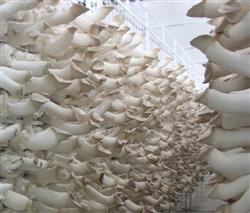
1. Humidity control. After the mycelium has fully colonized the bags, move them into the fruiting shed and arrange the bags for fruiting. Fruiting can use a stacked-wall type or bed-frame type. Control the humidity at 10-18°C. Below 8°C, the primordia are difficult to form or grow very slowly. Above 20°C with relatively high humidity, the mushroom stems become soft, and the fruiting bodies turn yellow, shrink, and rot, making them prone to contamination by foreign bacteria and pests. At 12-18°C, fruiting is faster, there are more mushroom buds, fruiting is uniform, and commercial quality is good.
2. Humidity. During the fruiting body formation stage of king oyster mushrooms, keep the relative air humidity in the mushroom shed at 85-95%. If the humidity is too low, the primordia are difficult to differentiate, crack, shrink, and stop growing. At this time, you can spray water on the ground and into the air of the mushroom shed. Never spray water directly onto the mushroom bodies, to prevent the fruiting bodies from turning yellow and affecting yield and quality. Especially under high-temperature and high-humidity conditions, it is even more likely to cause mushroom body rot, leading to total crop failure.
3. Air. Like other edible fungi, king oyster mushrooms need sufficient oxygen for the growth and development of the fruiting bodies. If ventilation is poor, the fruiting bodies cannot develop normally. During the primordium formation period, focus on moisture retention. As the fruiting bodies grow and develop, gradually increase ventilation to meet their growth needs.
4. Light. King oyster mushrooms do not need light during the mycelial growth stage, while during the fruiting body growth and development stage, scattered light can promote fruiting body growth, generally 200-1000 IX is suitable. Light can also help regulate the temperature of the mushroom shed.
5. Harvesting. Harvest when the mushroom caps open flat, the color becomes lighter, and the spores have not yet been discharged. After harvesting the first flush of mushrooms, clean the surface of the substrate and adjust the temperature so the mycelium has a 5-7 day recovery period, which helps the growth of the second flush. Overall, as long as management is good in king oyster mushroom cultivation, the conversion rate can reach as high as 100%, and it also has a short cycle, high price, and good market prospects.
Click to get more king oyster mushroom cultivation techniques
Click to get more edible fungi cultivation techniques