Key Technical Points for Off-Season Cultivation of King Oyster Mushroom in Cool Rooms
How to cultivate off-season king oyster mushroom in cool rooms? Please introduce. For cool-room cultivation of off-season king oyster mushroom, you can refer to the following methods: 1. Cool room construction. The cool room should be built on level, sunny ground at a relatively high elevation, close to a water source and with good drainage. Generally, each cool room is 10 m long, 6 m wide and 4 m high. The cool room should not be too large, otherwise it will be difficult to...
How to cultivate off-season king oyster mushroom in cool rooms? Please introduce
For cool-room cultivation of off-season king oyster mushroom, you can refer to the following methods:
1. Cool room construction
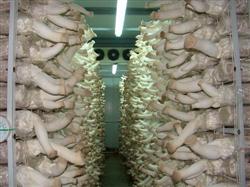
The cool room should be built on level, sunny ground at a relatively high elevation, close to a water source and with good drainage. Generally, each cool room is 10 m long, 6 m wide and 4 m high. The cool room should not be too large, otherwise it will be difficult to regulate the temperature. The walls and roof of the cool room are made of color steel plate with foam structure, and the bottom of the cool room is laid with foam and then poured with cement. The foam is 15 cm thick, and the joints are firmly bonded with sealant. The racks inside the room are made of steel pipes, with 8 tiers of bed frames, each tier 40 cm, and a working aisle left in the middle, 0.8 m wide. Each cool room has 1 door, located on the side. For connected cool rooms, 2-3 ventilation windows of 0.4 m x 0.6 m are left on the middle-upper part of the side of each room, with exhaust fans installed and sealed with fine gauze to prevent pests such as mushroom mosquitoes and mushroom flies from flying in. Doors and windows should also be inlaid with foam boards and sealed tightly. The refrigeration compressor is installed in the middle-lower part, with 1 unit of 10-horsepower compressor installed in each cool room, to control the temperature inside the cool room within a suitable range to meet the temperature requirements of king oyster mushroom. Movable doors and windows and fluorescent lamps are used to regulate light. Spray humidification is achieved by water pipe nozzles installed in the middle of the mushroom racks. Each cool room can cultivate about 10,000 bags.
2. Selection of excellent strains
At present, there are many strains of king oyster mushroom. It is recommended to use the king oyster mushroom strain bred by the Institute of Microbiology of Hebei Province.
3. Cultivation season
It is generally arranged as bag making from April to May, and fruiting from July to October.
4. Bag making and fruiting management
4.1 Culture material formula. The formula commonly used in king oyster mushroom cultivation is 78% cottonseed hull, 18% wheat bran, 2% corn (2346, 2.00, 0.09%) flour, 1% sugar, 1% gypsum, and 0.3% monopotassium phosphate.
4.2 Bag making. After the raw materials are added according to the formula, add water and mix the material. The material-to-water ratio is 1:1.2-1.3, so that the water content of the material reaches 60%-65%. The raw materials must be fresh, without mildew and without insect damage. Mix the material evenly and consistently; in particular, the cottonseed hull must not have dry particles, otherwise sterilization will not be thorough. After piling and stewing for 5-6 h, use 17 cm x 33 cm polyethylene plastic (11280, -35.00, -0.31%) bags to fill the material. The filling should be moderately tight. After tying tightly, carry out atmospheric pressure sterilization, raise the temperature to 100 °C, maintain for 14-16 h, and after the material temperature drops to 60 °C, stew for another 12 h before inoculation. During the production process, strictly prevent the bags from being punctured or worn through, so as to prevent contamination by miscellaneous bacteria.
4.3 Bag inoculation. For the sterilized bag material, inoculate when the material temperature drops below 30 °C. The inoculation room should be thoroughly disinfected. The inoculation amount is that each bag of spawn inoculates 25-30 bags. After inoculation, culture in the dark. After inoculation, pay attention to keeping the culture room clean, dry and ventilated, prevent the effects of high and low temperatures, and promote uniform mycelial growth. Check frequently. If bags contaminated by miscellaneous bacteria are found, move them out promptly for treatment to prevent spread. Generally, after inoculation, the mycelium can fully colonize the bags in 40-50 d.
4.4 Fruiting management. After the mycelium fully colonizes the bags, move them into the mushroom shed, and open the bags for fruiting after primordia appear.
4.4.1 Primordium induction stage. During the fruiting period, the temperature in the mushroom house should be controlled at 10 °C-20 °C, the day-night temperature difference at 10 °C, and the humidity at 90%-95%. Ventilate and exchange air every day and provide scattered light. After 10-15 d, mushroom primordia appear.
4.4.2 Mushroom growing stage. During the fruiting body growth period, the temperature in the mushroom house is controlled at 13 °C-16 °C, the humidity at 85%-90%, and timely ventilation should be carried out to keep the air in the shed fresh, with weak scattered light provided.
5. Pest and disease control
During bag making and cultivation management, king oyster mushroom is often contaminated by miscellaneous bacteria and invaded by pests and diseases. Common diseases mainly include green mold, red Neurospora, Rhizopus, etc. The main control measures are to strengthen ventilation, avoid excessive humidity, and promptly remove diseased mushrooms if found. Common pests mainly include mushroom mosquitoes, mushroom flies, etc. The damaged culture material turns dark brown, mushroom primordia cannot form, and formed primordia and young buds will also shrink and rot. Preventive measures should be given priority, with integrated control measures. The methods are as follows: first, isolation and protection, installing 60-80 mesh window screens on the doors and windows of the cool room to prevent adults from flying in and laying eggs to reproduce; second, light trapping. Adults are phototactic and can be trapped and killed with black light lamps; third, chemical control. After the bags are opened and after harvesting, spray the material surface with 5% fipronil emulsifiable concentrate at 1,500 times dilution or 25% acetamiprid at 3,000-4,000 times dilution for control.
Click to get more king oyster mushroom cultivation techniques
Click to get more edible mushroom cultivation techniques